Five Years of tedohara.net

I noticed last month when I renewed my domain registrations that it’s been five years since I first set up this site. I meant to say something on the actual anniversary, but it slipped my mind.

I initially set up the site because I was concerned about my job. I felt uncertain about the company’s prospects, and was unhappy with the commute, and felt that as a web developer, I’d be more credible if I had my own site. I wanted to be able to show off my CSS and JavaScript skills. To my mind the actual content was secondary, though I figured I’d have some web development posts.

I knew from my own browsing that I wanted to use WordPress, but it took me a nearly a year to get to find a host and actually get going. I’d say it took me several months from thinking “I should do this,” to actually starting to look into hosting companies, and then a few months of frustration of looking at hosts casually, to a couple of months of thinking about it more seriously, to a month or so of trying to decide, to actually pulling the trigger on DreamHost.

I requested the domain on a Thursday night, August 11, 2011, and the domain became reachable on the internet the following day, with a ‘parked’ site. I spent Friday night setting up emails and excitedly exploring the DreamHost control panel, and finally that Saturday morning, I downloaded and installed WordPress and made my first post.

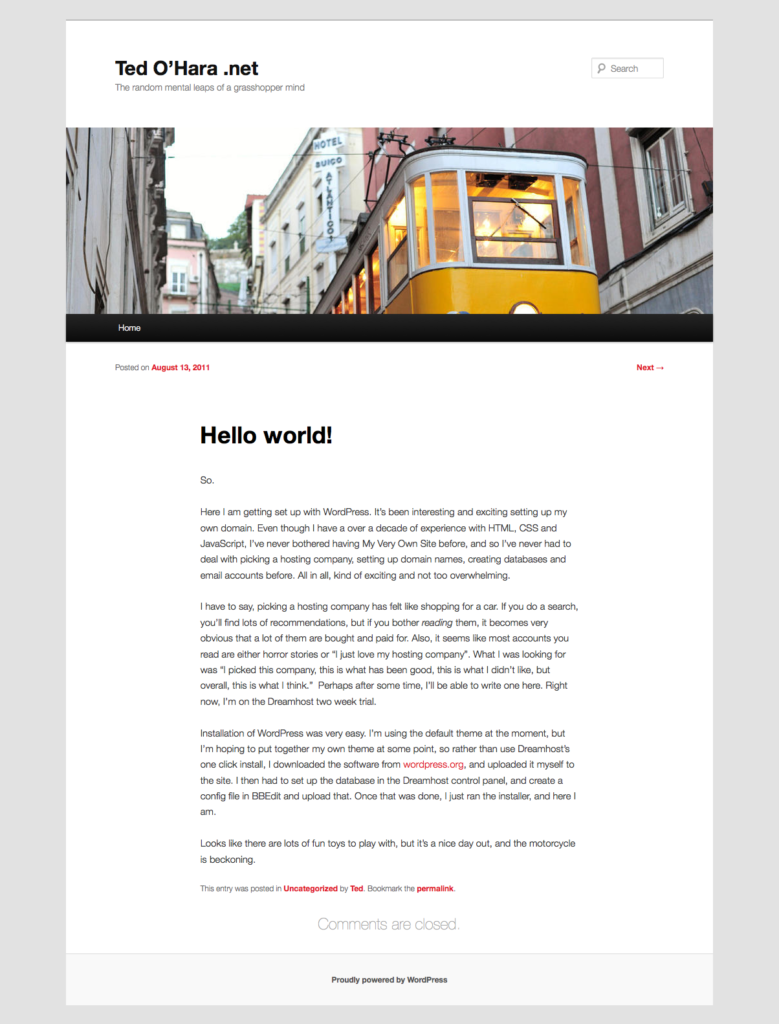
My First Post, using the stock Twenty-Eleven theme and imagery.

My first post, using the stock Twenty-Eleven theme and imagery.

I knew I wanted something more custom, so I quickly customized the header images. Still, I knew I wanted something less generic looking, but I wasn’t sure what I wanted. I also didn’t know how to implement what I wanted once I figured out what I wanted. I initially thought I needed to write my own theme, but stumbled upon child themes, and figured out how to implement what I wanted over the 2011 holidays. The present theme debuted New Years Eve of 2011.

As I said, initially, the content was secondary to simply having a site, though I did want to focus some on web development. Over time, I’ve done fewer work related posts, and it’s become more of a place where I can show off my pictures, talk about things I’ve done, or simply spout off about something. I do try to post something at least once a month, but otherwise, I post when I have something to say.

I’m under no illusions that many people are reading this. I’ve long suspected it’s basically my sister, my mother (hi Mum!) and occasionally my dive buddies, and when I finally installed Jetpack in May, the stats tend to back this up. My post “I Expect My Leaders to be Grownups” did get some notice, chiefly because I @ replied to something Marco Arment posted to Twitter with a link to the post, and he retweeted it to his 100,000 followers.

Still, it’s nice having my own site. It gives me a place to talk about things if I want, and a place to post my photography. It’s also nice owning a domain name, as it allows me to create sub-domains and create email addresses at will. And I agree with Marco Arment that it’s best to own your online identity.

So what’s next? I tinker with things periodically. A few weeks back I switched the sidebar from the right to the left, and I’ve been experimenting with adding Twitter support. I switched over all the imagery to retina quality over the past year. I’m aware that my current theme is getting long in the tooth, but for better or worse, I like the way it looks, so I’m not sure what to do. Right now, I’m leaning towards creating a version that keeps the basic colors and typography, but is more responsive, handling both larger and smaller sizes better.

Stay tuned.

July 4th on the Charles

I spent Fourth of July watching the Boston fireworks on the Charles from my kayak. Without a doubt, it’s the best way to see the fireworks.

I’ve done this a couple of times now; Charles River Canoe and Kayak rents boats from their Brighton and Kendall Square locations for the event. The first time couple of times I did it, the atmosphere was very relaxed, and there was a lot less security. I remember one year seeing a couple of guys on a raft made up of office water cooler bottles, and people on floating rafts; after the marathon bombing, security was tightened up. The last time I did it, in 2013, all boats had to be anchored by 7 and there was a Coast Guard boat with a big black machine gun on the front deck patrolling the river.

This was the first year I did it in my own boat. I put in from Herter Park, just downstream from Charles River Canoe and Kayak, around five-thirty-ish, and got to the Mass Ave bridge a little past 7. There were already a bunch of boats there, some of them fairly large. Boats were required to anchor by 8:15, but I felt like a motorcyclist among a bunch of SUVs with all the boat traffic, so I waited until nearly 8 to anchor. I wanted to be able to move if a boat did something stupid.

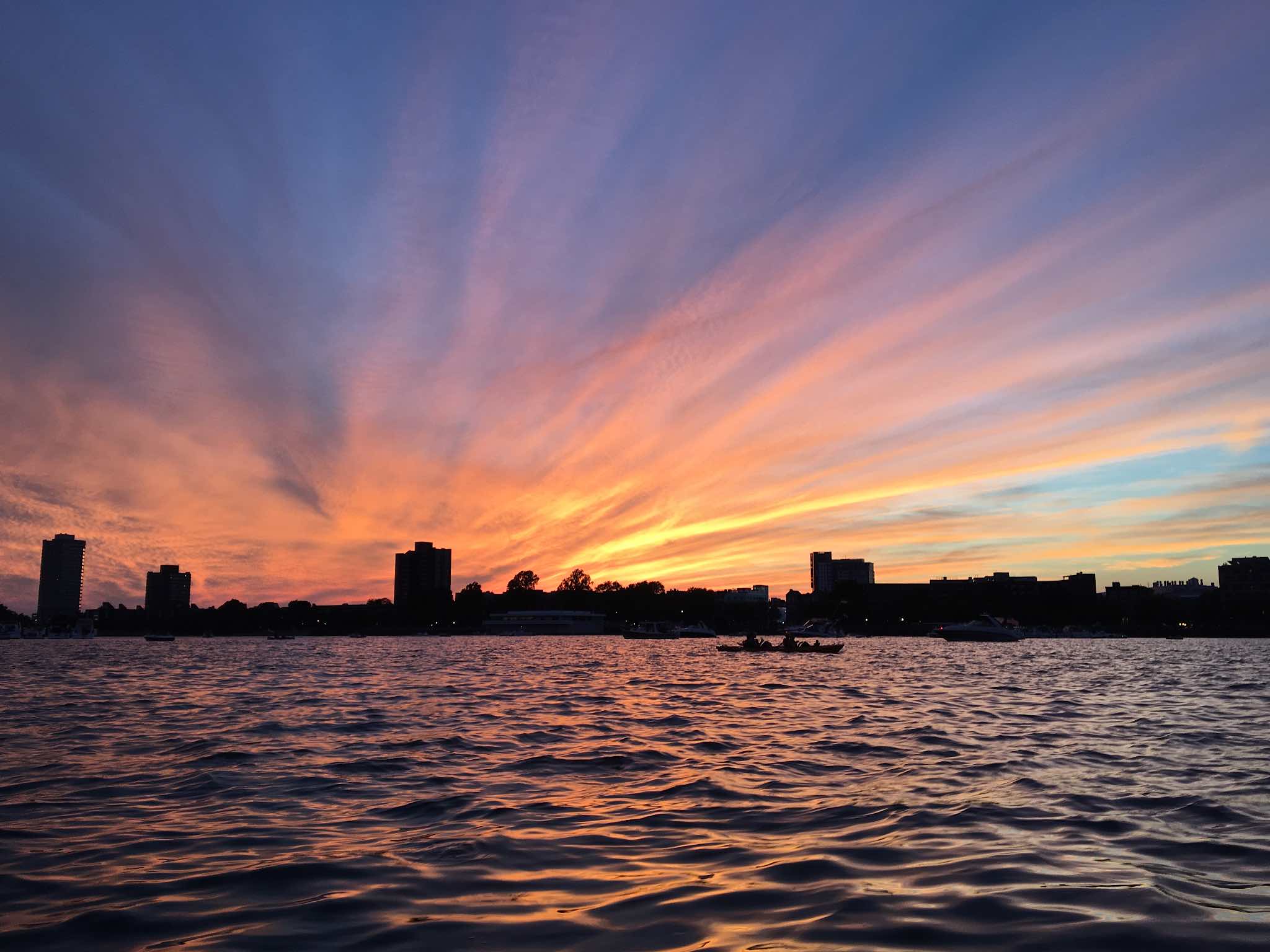
Once I anchored, there was nothing to do but wait. Fortunately, the weather was gorgeous: clear, not humid, not too warm. There was enough wind to raise a little chop, but it kept the bugs away. It was really nice just sitting there in the boat. We were treated to a spectacular sunset:

Sunset, July 4th

Sunset, July 4th

This year, the concert and fireworks were on network television. I’ve been to years both with and without the network, and I much prefer it when network TV isn’t calling the shots. This year, they played the 1812 Overture fairly early, with a small display of fireworks, and then there were 90 minutes of filler country music until the main show at 10:30, timed to end just before the 11:00 news.

But, oh, what a show it was. It made the wait worthwhile. Not only did they shoot them from the barge, but they launched sprays of fireworks from the Mass Ave bridge itself, and I was close enough to the bridge to feel the heat from the fireworks. There were jets of fireworks flying up from the length of the bridge, with sprays of light in the sky beyond. It was magnificent.

Finally, though, came the finale, and then it was time to up-anchor and head back. It was kind of cool kayaking in the dark, part of a stream of boats heading upstream. Each boat had at least a light, and several of us were adorned with a number of glow sticks. I’d been worried about pulling out of the river, but I found the exit pretty easily, and was able to get out without a problem. All in all, a wonderful night.

Pinkerton Over Timberlane

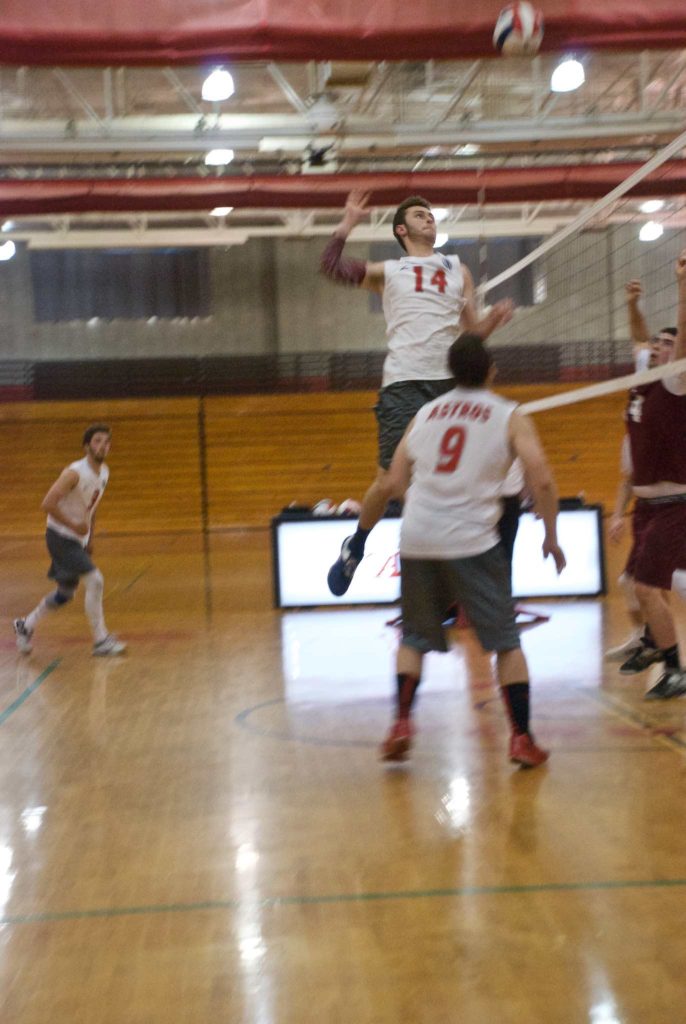
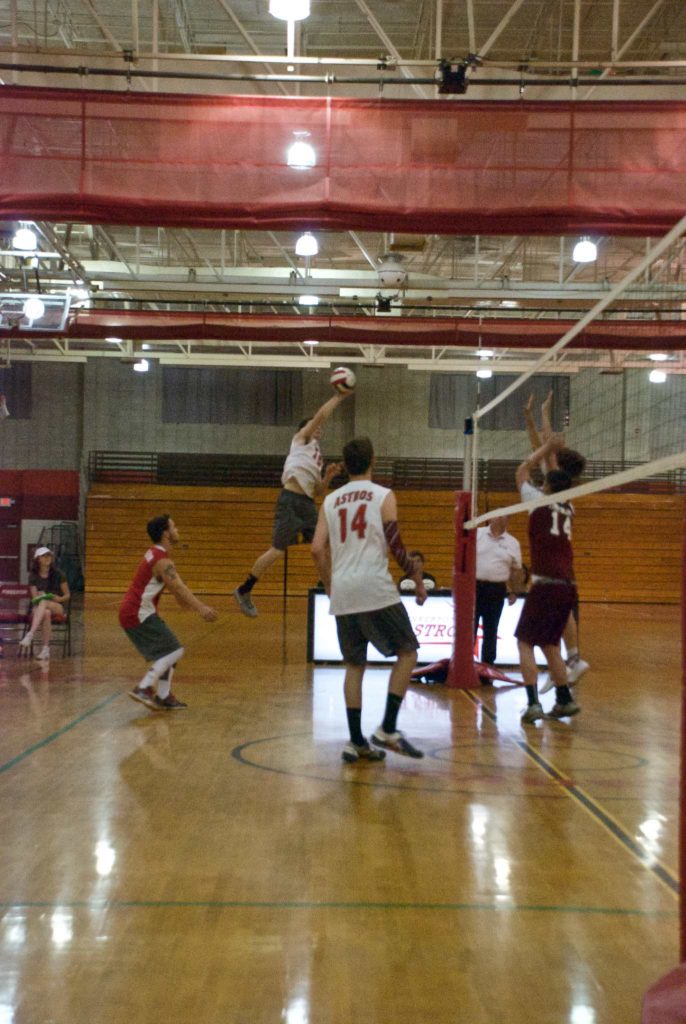
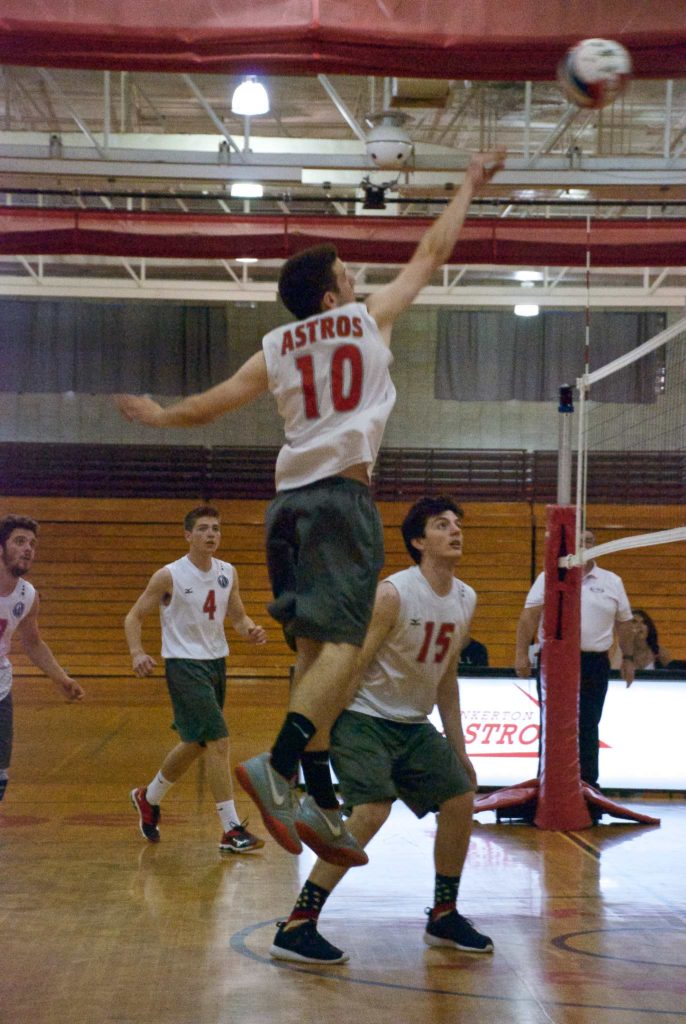
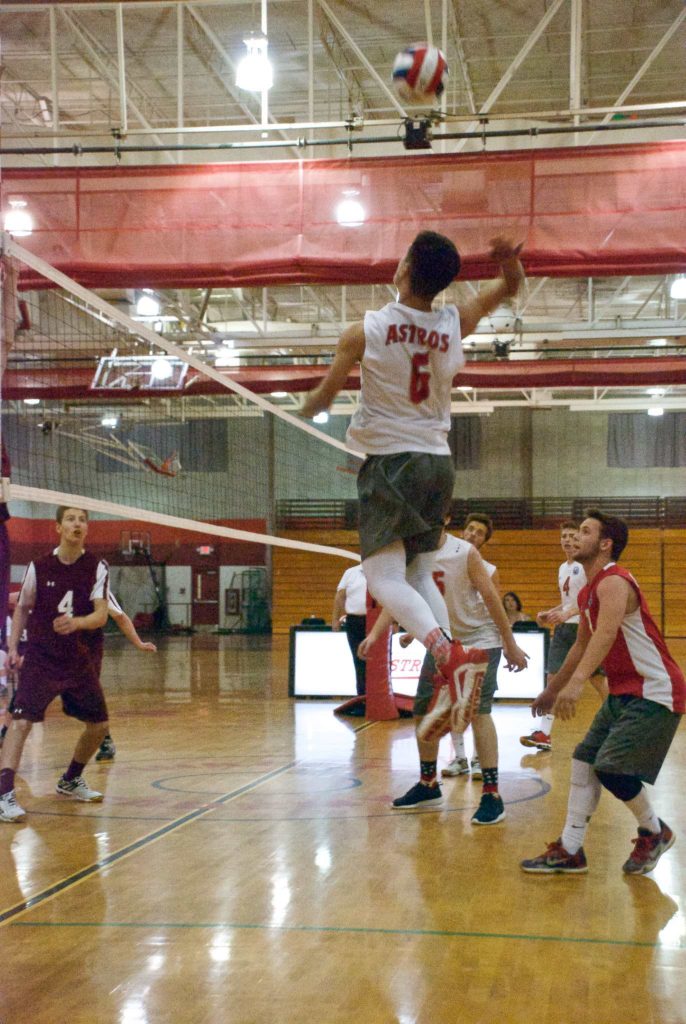
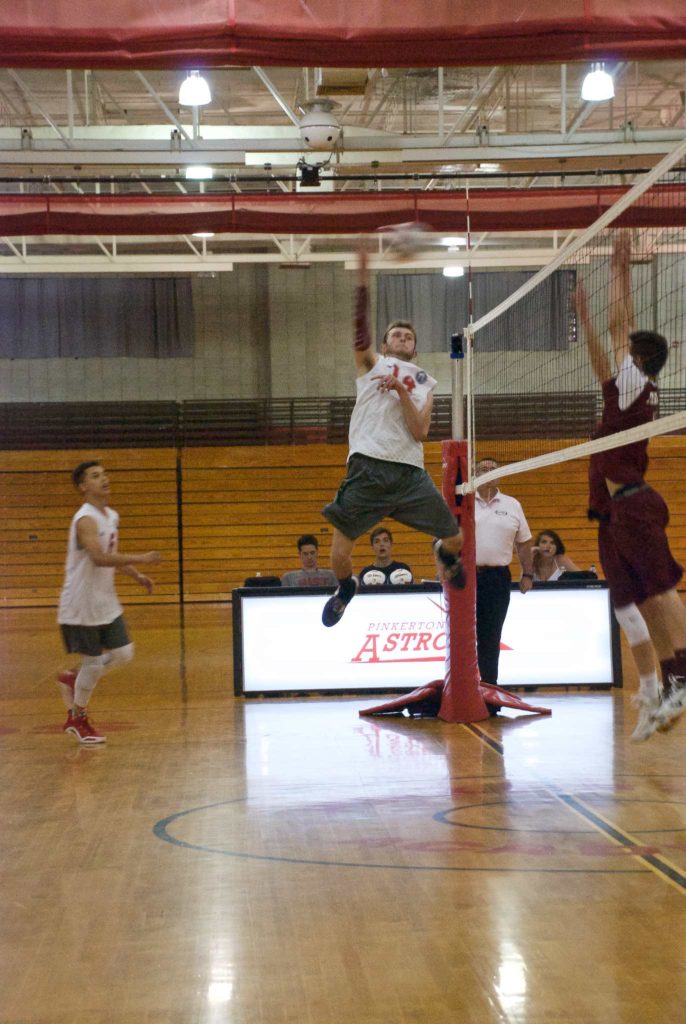
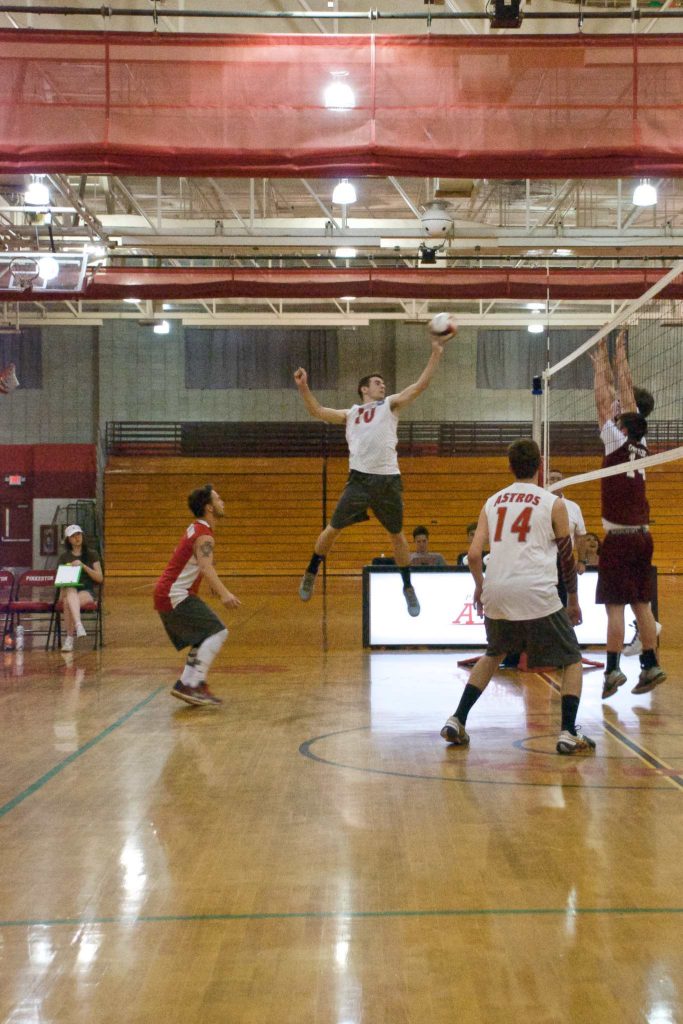
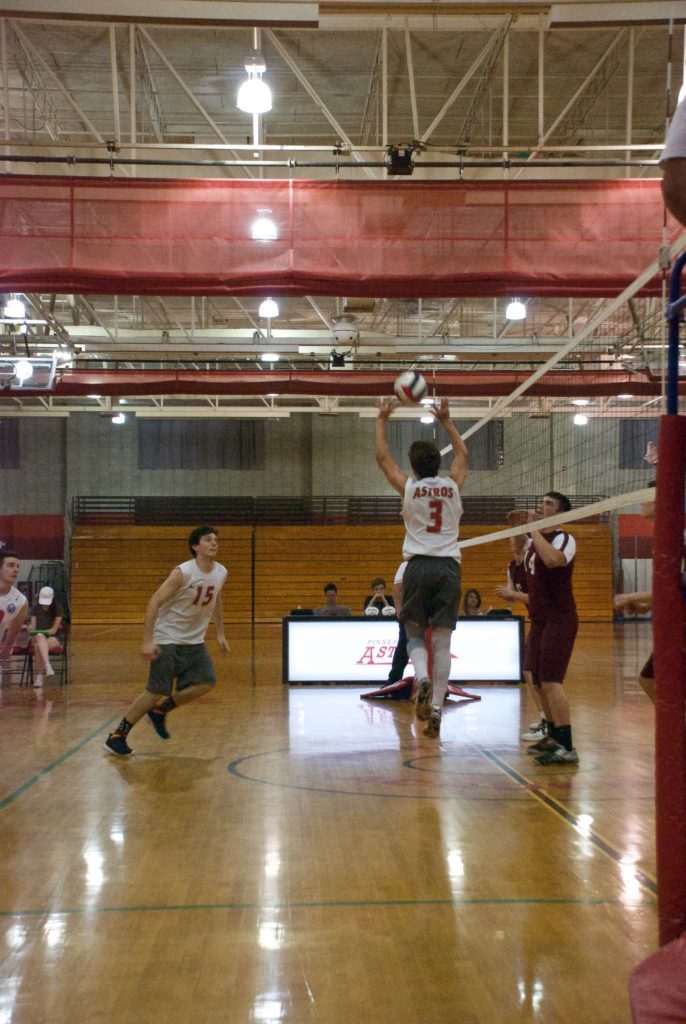
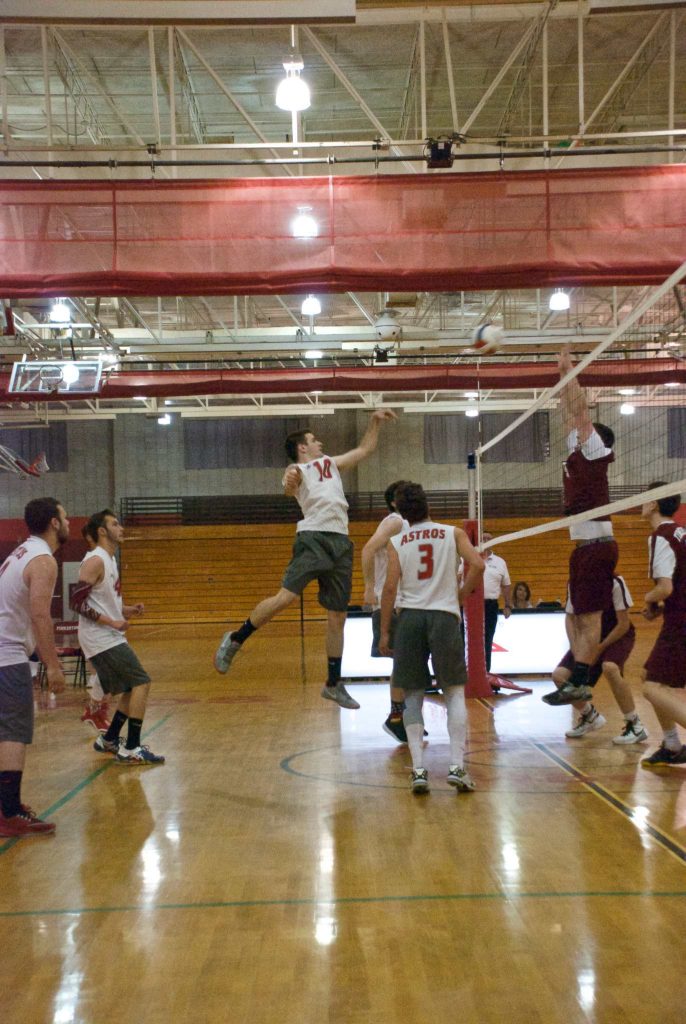
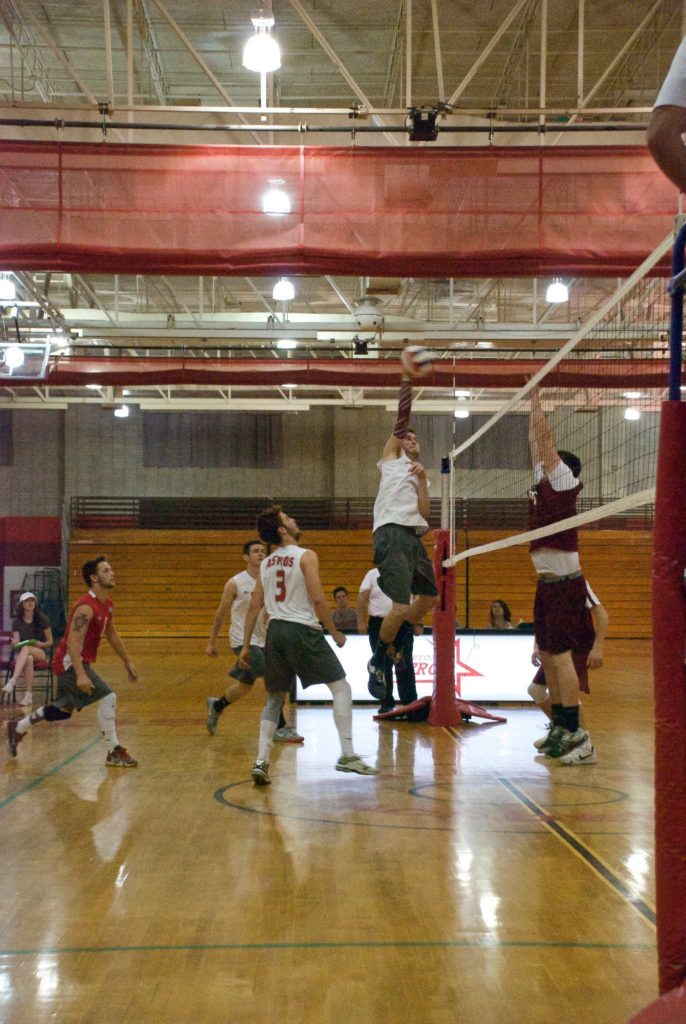
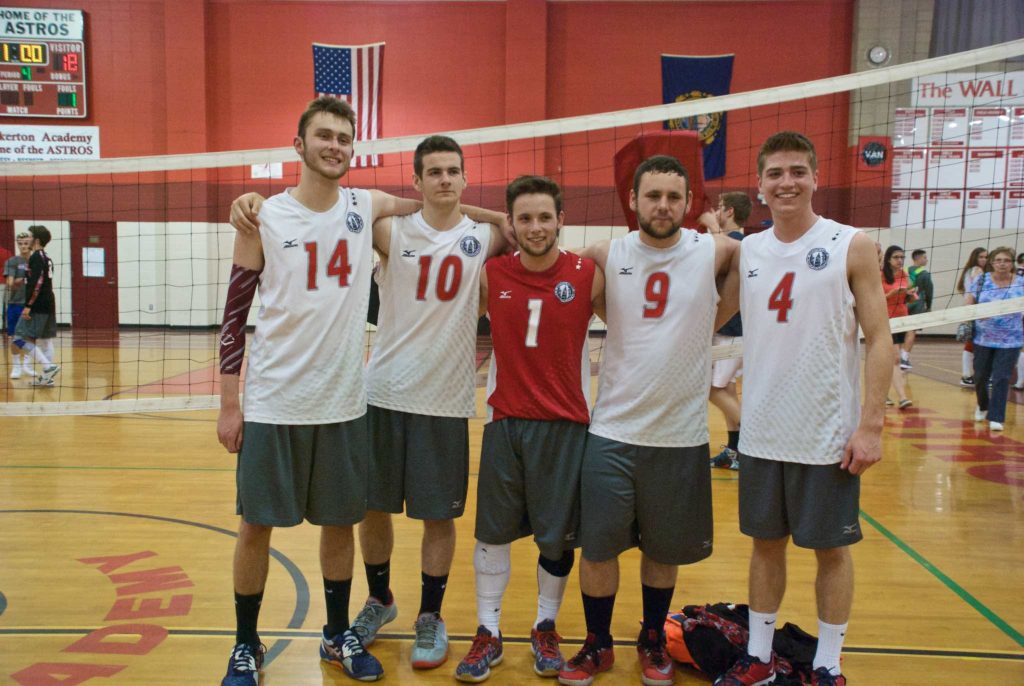
I took a vacation day today to see my nephew Matt play his last home volleyball game at Pinkerton Academy. The team is in second place, and they were playing the first place Timberlane Athletics. The Astros won 3 games to 1; all four games were very close.

Me being me, I took some pictures. Well, OK, 183 pictures to be exact. Here are a few:

Matt Erb spiking

Matt Erb spiking

DSC_0145

DSC_0085

Matt

DSC_0100 DSC_0106 DSC_0114 DSC_0130 DSC_0131 DSC_0144 DSC_0145

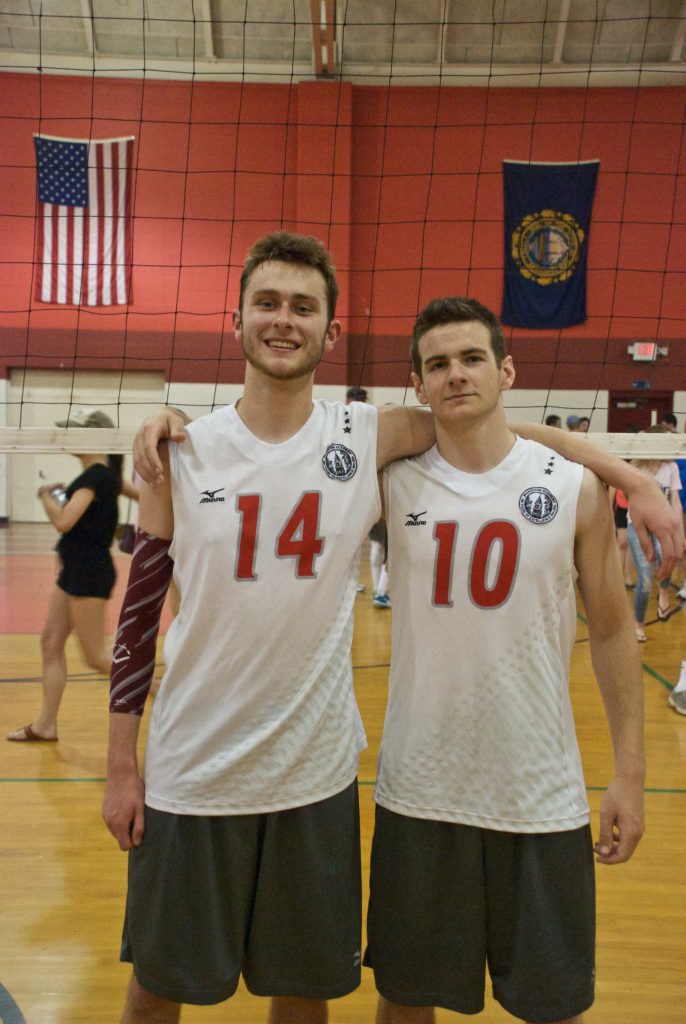
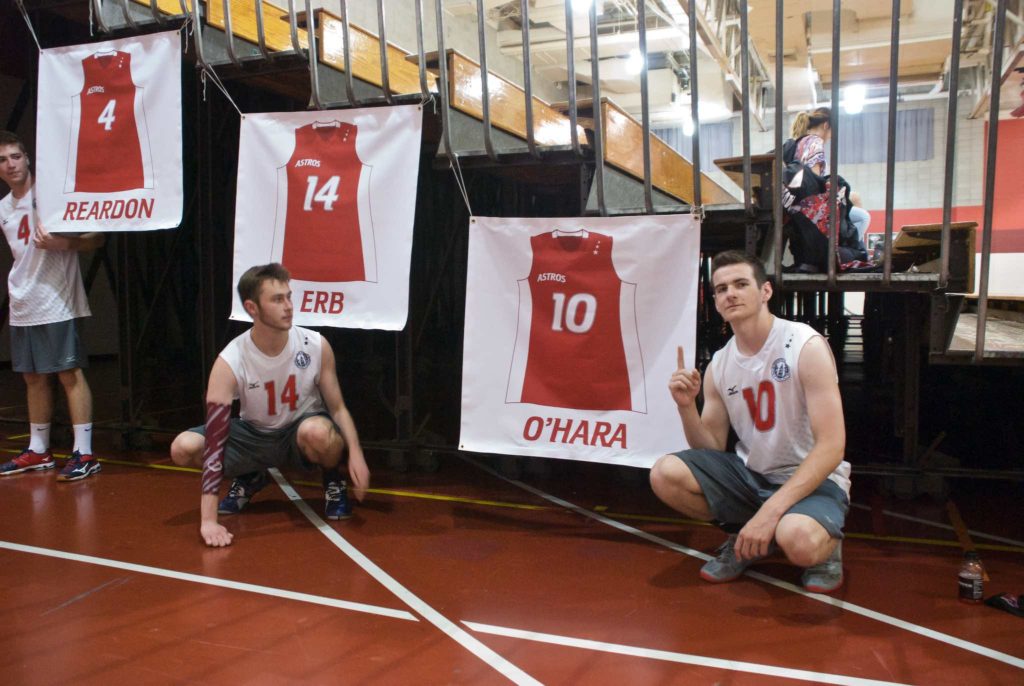
Matt Erb and Matt O'Hara

Matt Erb and Matt O’Hara

Seniors

Seniors

Shirt Banners

Shirt Banners

Focus 40

I attended the Focus 40 event at Northeastern tonight. Sponsored by the Massachusetts Department of Transportation, it was designed to focus on envisioning the state of transportation in the Greater Boston and 2040. Although a planning session for the T, the panel discussion actually said very little about the MBTA. It was more about what the role of government vs private enterprise should be, how climate change will potentially affect the transportation system, and potentially how new technologies such as Uber or Lyft, or self driving cars are the way of the future.

It was all very interesting, and there were a number of very well known people there. Transportation Secretary Pollack and another state Cabinet officer opened the talk, and I saw the new General Manager of the T there. Former Transportation secretary (and father of the Big Dig) Fred Salvucci spoke from the floor, and former Governor Dukakis was there.

For me though, it was a little too orientated toward transit advocates. A couple of panelists, when asked for a headline from 2040, announced the last of the private automobile. I’m not having it, at least not entirely. I don’t dispute the appeal of on-demand ride sharing programs like Uber, but I’m not as bullish on autonomous vehicles. For one thing, if everyone has their own self driving car, that’s still a ton of congestion on the road. More importantly, though, they overlook how enjoyable and empowering it is to drive oneself.

I like to drive, and I know my brother likes to drive even more than I do. They say things like you could read or relax while on the train or in a self driving car, but I’d much rather be the driver than a passenger.

I’ve been a rail fan since I discovered the subway commuting to BC. But we moved our office from Newton to downtown Boston in December, and I’ve been chafing at riding the commuter rail since. It’s a lot more expensive than driving to Newton, and a lot more inconvenient in many ways. Driving, I could be a few minutes late and not worry; taking the train, if I’m a couple of minutes late, I’ll miss the train, and have to take the next one — and the gaps between trains are long. I used to work late quite often; now I have to drop things in the middle in order to be sure of catching the train — after 6:15, the gaps between trains are even longer. The trains are too crowded to read easily*. And paradoxically, I’m riding my bicycle much less. I used to keep it in the back of the car and go for a ride after work; now, I don’t have the bike with me, and I don’t have the time to go someplace after getting back to the station.

Personally, I suspect transportation in 2040 will be much like transportation now. There will still be people driving themselves, either because they can afford to, or they like to, or are going someplace the system doesn’t easily serve. I think the rapid transit and commuter rail systems will still be vital, simply because of their capacity to move a lot of people at once. I do think ride sharing programs like Uber and Lyft will pick up a lot of the “last mile” traffic, and bleed some usage from the bus system. I suspect buses will be routed much more dynamically than they are now,  and possibly even on demand. I think a bus route could be managed by an autonomous vehicle, but I also believe that the unions will be able to block it from happening for a while. And hanging over all these trends is the risk of catastrophic weather caused by climate change causing heavy damage.

* On the reverse commute to Providence this was not the case.  

Hornblower

My new copy of The Hornblower Companion, by C. S. Forester, arrived last week. It’s a companion book to the Horatio Hornblower series of books about a British naval officer during the Napoleonic era. Besides containing a set of maps showing where each of Hornblower’s adventures took place, Forester describes his writing style, and explains how each of the books was written. It replaces my very well worn original copy.

When I think back, a quote from the Companion was among the first words I read about the series. I was eleven or twelve, and had found a Reader’s Digest volume of condensed books; among them was a condensed version of Beat To Quarters, the original volume in the series. The preface contained Forester’s comments from the Companion describing the setting. And then I dove into Beat To Quarters:

It was not long after dawn that Captain Hornblower came up on the quarterdeck of the Lydia. Bush, the first lieutenant, was officer of the watch, and touched his hat but did not speak to him; in a voyage which had by now lasted seven months without touching land, he had learned something of his captain’s likes and dislikes. During this first hour of the day, the captain was not to be spoken to, nor his train of thought interrupted.

The book is about a British sea captain who has been sent on a mission to support a rebellion in Central America against Spain. To prevent the Spanish from finding out, he has orders to avoid sighting land until he arrives in the Gulf of Fonseca, to meet with the leader of the rebellion. He accomplishes his orders, and after seven months at sea, manages a perfect landfall, only to find the leader is a madman who has decreed himself to be El Supremo (the Almighty). Nonetheless, he carries out his orders, is able to capture a much larger Spanish ship, the Natividad by surprise, and turn her over the rebels. After the two ships part, Hornblower finds out that during the time he was out of communication with the Admiralty that a treaty has been signed with the Spanish, they are now allies, and he now has to fight the larger Natividad – in open waters, without the benefit of surprise. Complicating matters, he has provide passage back to England to an English lady, (the sister of the Duke of Wellington) who has been stranded in Panama.

I just lapped that book up. My father had passed down his love of nautical lore to me, and Forester has an admirably clear and easy to read style. There’s plenty of adventure, and Hornblower is very human too – he’s quite self conscious, and has no self confidence. For example, he would rather lead than drive, and then condemns himself for being too soft.

I finished the condensed book, but didn’t realize exactly what I was missing, or that what I’d just read was the first book in a series. Then, one day, about a year later, I was cleaning up downstairs and found a boxed set of Captain Horatio Hornblower: Beat To Quarters, Ship of the Line and Flying Colors in one set. It’s easy for me to date the time I read them: Christmastime when I was in the 8th grade. I distinctly remember being buried in Ship of the Line during the week before Christmas; the rest of the class was making a lot of noise, and I was just absorbed by the adventures of HMS Sutherland. Sister Theresa Ann came in, and I was the only one who didn’t get in trouble, because I was too wrapped up in Hornblower to get into trouble.

After finishing those books, I went to the library and read the other books in the series. And much later, I bought my own copies of all eleven books, plus the Companion. I’ve reread them all dozens of times. For a while, it was a personal Christmas tradition to reread Ship of the Line at Christmas time.


I have a special fondness for the Companion. Forester and Isaac Asimov are my two favorite authors, and in the latter part of the Companion, Forester describes his writing process. First, he comes across something that he recognizes as the basis of an idea:

…It happens that…the initial stimulus is recognized for what it is. The causal phrase dropped by a friend in conversation, the paragraph in a book, the incident observed by the roadside, has some special quality and is accorded a special welcome. But having been welcomed, it is forgotten, or at least, ignored. It sinks into the horrid slime of my subconscious like a waterlogged timber into the slime at the bottom of a harbour… [At some point] the original idea reappears in my mind, and it has grown.

From there, he describes how the plot gradually comes together for him. Unlike Asimov, he did all his plotting ahead of time. Gradually the plot starts to demand more and more of his attention. And then it comes time to actually write. Unlike Asimov, who was incredibly prolific because he enjoyed the process of writing, Forester found writing to be painful and fatiguing:

The happy-go-lucky methods of the jellyfish have to be abandoned for the diligence of the ant and the endurance of the mule. For me, personally, the change of state occasioned by starting to write is abrupt and violent. It is the difference between standing at the top of the  toboggan slide and starting the descent. It is taking the plunge, swallowing the pill, walking through the door marked “Abandon All Hope.”

In I, Asimov, his (third) autobiography, Asimov described how he enjoyed reading his own writing:

A prolific writer… has to love his own writing.

I do. I can pick up one of my own books, start reading it anywhere, and immediately be lost in it and keep reading until I am shaken out of it by some external event.

By contrast, Forester was deeply self critical of his writing. In the Companion, he compares reviewing his own work to an “ugly woman” looking at her make-up in the mirror to see if anything can be done, and asks, “Can a finished book ever be as good as the book the writer dreamed of before he started writing it?”

And yet, as an adult, part of the reason I still enjoy the series is Forester’s command of the language. He clearly has a sense of the sound and the rhythm of his words.  I love this passage describing the tactics of composition:

The words must be chosen, the sentences devised, which most accurately and most economically – and most suitably – describe the scene I am witnessing…An awkward sentence may bring the reader back to reality, just as a breaking stick may alert the feeding deer.


Hornblower has served as the inspiration for a lot of writers, among them Gene Roddenberry, the creator of Star Trek, and Nicholas Meyer, the writer and director of Star Trek II, the Wrath of Khan. Captain Kirk was modeled on Hornblower.

So if I’ve convinced you to read the series, where should you start?  There are two ways to do it. You can read them in the order in which they were written, as I did, starting with Beat To Quarters. Beat To Quarters was originally intended to be a standalone novel, so it’s more self-contained. It also means there are more inconsistencies with the rest of the series. As he filled out Hornblower’s life, Forester became more aware that he was writing a series and paid more attention to continuity. Or you could read them chronologically, starting with the beginning of his career as a seasick seventeen year old in Mr Midshipman Hornblower, continuing all the way to Admiral Hornblower in the West Indies. Whichever way you decide, you’re in for a treat.

Restoration

I was looking through my old negatives to see if I could find the negative of the picture of my Dad that I posted last September, when I came across yet another box of slides. The box contained a bunch of rejected slides, pictures that were either too light or too dark to be part of a slide show. That was then. Now, we can edit pictures digitally, so I figured they were worth a second look. I found about fifteen that looked like they might be worth a quick scan to see if there was anything worth the work of fixing them.

Of the first four, this was the most promising. It’s a picture of my sister and me from 1963, taken by my father.

Nancy and Me - before

Nancy and Me – before

It looks like it was from the tail end of a roll — light fogged at the right and top, and covered with fungus.

Nancy and Me - After

Nancy and Me – After

Not bad at all. So what did I do?

  1. I cropped much of the fogged area out of the picture. (The ‘Before’ picture is actually cropped).
  2. I added an initial overall Curves adjustment to make the darks darker and the lighter areas lighter, and adjust the color.
  3. I added a second Curves adjustment on top of the first, masked with a layer mask with a very soft bottom edge, over the top half of the picture. This layer makes the top part of the picture darker and more contrasty, and further adjusts the colors.
  4. Used the Spot Healing Brush to clean up the biggest bits of dirt on the scan. Things like hairs and especially large clumps of mold.
  5. Cleaned up some (but not anywhere near all) of the mold tendrils on the faces. Just the very largest spots — there was way too much mold damage on this picture to spot them all away individually.
  6. Dealt with the blue mold spots. These occur where the fungus has eaten through the yellow dye layer of the emulsion. For some, like the blue spot on my face, and some of the blue spots on the couch, I used the Clone Stamp Tool. In other places, like along the back wall and the spot in my sister’s hair, it was sufficient to use the Sponge Tool to desaturate the blue away.
  7. I used the Sponge Tool and Burn Tool to desaturate and darken the edge fogging on the right side of the picture.
  8. Finally, I duplicated my layer, ran the Dust and Scratches filter on it, masked it, and then removed the mask away from any edges.

The problem with the Dust and Scratches layer is that it works by blurring the spots away, and can also blur away detail. Usually, I only need to unmask the Dust and Scratches layer where there are dust spots. Usually, if there are particularly bad areas, they’re confined to the sides, which are out of focus anyway. Not this picture. I had to accept this image was not going to be as clean as I’d like.The fungus damage was way too extensive, and covered every square millimeter of the film. So I unmasked everything away from any sort of edge. For example, I unmasked the skin if the faces, but left the edge of the lips and eyes from the base layer showing, to retain the sharpness of the edges.

Overall, though, considering the state of the original image, not too shabby, even if I do say so myself.


iPad Pro, 9.7 inch

I picked up a new iPad Pro 9.7 inch a couple of weeks ago. I got the gold cellular model with 128 GB of storage, along with the Apple Pencil. Last night, I picked up the Smart Keyboard and silicone case to go with it. This post is literally the first thing I’ve used the keyboard for.

To be honest, I got it more because I wanted to upgrade my existing third generation iPad than because of the “pro” features. The old iPad had gotten very slow, and I’d been disappointed when Apple introduced the big iPad Pro rather than an iPad Air 3. I like the original iPad screen size. Continue reading

Shenandoah

For as long as I can remember, there’s always been a sign on the Cape house, “Shenandoah”. It’s unclear whether my father or one my uncles carved it, but “Oh, Shenandoah” was a popular song around the time the house was built in the mid-sixties, and as my Uncle Tom points out, it was a favorite song of my cousin Susan, who died at fourteen after being thrown from a horse right around Christmas of 1965. It’s of great sentimental value to my family. Continue reading

I Expect My Leaders to be Grownups

One of the things the media enables is bomb-tossing. It encourages extreme reactions on both sides. And so, it was disappointing, but not surprising, that within hours of the announcement of Justice Scalia’s death, the Senate Majority Leader was talking about not allowing a nomination for his replacement to come to a vote.

Just as parents expect good behavior from their children, I have certain expectations from my leaders. In neither case, is an expectation a guarantee. In both cases, when expectations are not met, there should be consequences. 

I expect my leaders to do their duty.

I expect them to fulfill the requirements of the jobs they chose to run for, and were elected to. If they want to grandstand or pontificate, they should get a job in the media. At the end of the day, I expect them to be grownups, to understand they can’t hold us hostage until they get exactly what they want. I expect them to come to an accommodation with each other.

It’s absurd to expect the Court to run with a vacancy for a full year. It would mean too many tie decisions, too many cases put over for re-argument, too much delay processing certiorari petitions.

It’s also absurd to say that there can’t be nominations made during an election year. Many justices have been confirmed in presidential election years, including Anthony Kennedy.

What I Expect From the President:

I expect the President to nominate someone Senate Republicans can live with. I’m not saying he should nominate someone they would whole-heartedly endorse, just someone they can accept. The President needs to accept the fact that the majority of the Senate is controlled by conservative Republicans. I’m not saying he needs to nominate another Scalia; I’m saying it’s not a time to nominate another Kagan (not to disparage Justice Kagan; I like her a lot).  He needs to find a middle of the road candidate. He should in fact, solicit the advice of both sides of the Senate. He would probably be better off if he did this privately.

What I Expect From the Senate:

I expect the Senate to give whomever the President nominates an honest consideration and an honest vote. I expect the Senators to recognize that he is the President, and that, according to the Constitution, it is his duty to make the final nomination. They need to recognize that whoever replaces Justice Scalia is not going to be as conservative as he was, just as liberals in 1975 had to accept that whoever President Ford appointed would not be as liberal as Justice Douglas.

If the President solicits their advice, they should give it. It would be more productive if they gave it to him directly rather than through the media.

I do not expect the Senate to rubber stamp a nomination. If the President were to send them a nomination that was clearly unsuitable, constitutionally, they do have the right to withhold their consent. But they need to recognize unpalatable is not the same as unsuitable. I do expect them to act on his nomination.

What I Expect from the President and the Senate:

I expect both sides to remember that the other party has prerogatives, and a Constitutional role in this process. I expect both sides to realize that the Court should not be expected to limp along for a year. I expect them all to be grownups, and realize that they are all not just members of political parties, but Officers of the United States of America, and (like any job), their office requires them to sometimes do things not exactly the way they want it. Realistically, I also would remind them that what comes around goes around, and at some point, their political fortunes will be reversed.

I expect them all to do their duty to the country I love.