This gallery contains 42 photos.
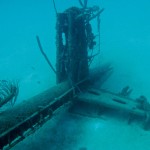
Wednesday was a four dive day: In the morning, we all dove the wreck of the Hilma Hooker, and then the Salt Pier, in the afternoon, Henri and I did two dives on the house reef.
This gallery contains 42 photos.
Wednesday was a four dive day: In the morning, we all dove the wreck of the Hilma Hooker, and then the Salt Pier, in the afternoon, Henri and I did two dives on the house reef.
This gallery contains 18 photos.
Tuesday morning I did Weber’s Joy with the Hinzes and Alec and Nick, Tuesday afternoon, the Nolans, Henri Menco and I did Dee Scarr’s Touch the Sea program, and in the evening, I did a dusk dive with Jack and … Continue reading
This gallery contains 25 photos.
Monday morning we went on a pair of shore dives to the north of the resort; the first site was called “Oil Slick Leap” and the second one I’ve always known as “Old Blue”, but is now marked as “Tolu”. … Continue reading

This gallery contains 18 photos.
I started shooting with our first boat dives Sunday afternoon. For the first one, Paul had the boat take us to see a bait ball of fish, which is a swarm of fish spinning and swimming madly in all directions. … Continue reading
I’m still post processing all the pictures from the Bonaire trip. For some, it’s merely a matter of looking at the sharpness of the picture, realizing that it will never be good, and rejecting it. (I’m at the stage of the game where I’m starting to look forward to those.) For the rest, it’s sometimes a matter of correcting the exposure, and for nearly all of them, correcting the color. My attitude is that even a mediocre picture should be corrected, since occasionally you’ll have a picture “come up” in a surprising way.
Part of the problem is my camera settings. I’m realizing after the fact that I was getting more of a mix of ambient light, (which is lacking in red) and strobe light than I realized. There were some times when I was trying to use mixed light, in order to get a colorful background, mostly I was looking for a straight strobe exposure. I was aware that they looked a little green on the camera screen, but they basically looked OK, so I let it go. In hindsight, I should have bumped up the strobe power a bit, and lowered the camera ISO.
So now I’m color correcting. Endlessly. My tool of choice is Apple’s Aperture 3. This version features a Curves adjustment, which often does a very good job. Previous versions, I’d try a Levels adjustment, which would sometimes work, but often not, and wind up using Photoshop’s Auto Levels which often does an amazing job, or Photoshop’s Curves, which I didn’t understand well back then. Photoshop is still my “nuclear option”, for cases I still can’t correct in Aperture, but there are far fewer of them.
The advantage of Aperture is that it doesn’t apply your adjustments to the picture and create a new picture, it saves the adjustments separately from the master photo, so they can be turned on or off, and take up much less disk space. They’re sort of like adjustment layers in Photoshop. When Aperture has to send a picture to another editor though, to preserve the master, it creates a duplicate master with your current adjustments and sends that to the other editor. This takes up more disk space. Photoshop’s Auto Levels still does a better job in some cases, but I find it’s Curves adjustment to be more fiddly than Aperture’s–less of a mouse move makes more of an adjustment.
So how does Curves work? For each color, you see a diagonal line over a histogram for that color, or over a histogram of the luminance. Pulling the line down curves it downward, and makes that part of the picture darker in that color; dragging it up increases that color. You can also adjust where the black and white points should be for that color. So for my underwater pictures, I’m typically adjusting the red white point more to the middle, since often there’s very little red, and then dragging the red curve upward a bit. This sometimes makes the shadows too red, so I adjust the red black point to compensate.
A lot of the pictures are lightish, so instead of increasing the red, I’ll decrease the green and blue instead. I usually start with the green, adjusting its black point and bellying the curve downward a bit, then I’ll go to the blue to finish off. Generally the blue takes less correction.
Some of the results are really good, but it’s all very tedious, and more clicky than it needs to be. You can set an auto gray point, but very few of the pictures actually have a gray in them. In addition, for each picture, you have to click to enable the Curves adjustment (I’ve added it to the default set), then choose a channel from a drop box. It would be nice if it just had buttons for the channels.
So far, I’ve gotten to Thursday’s pictures, and I haven’t added any metadata or assigned ratings yet. I still have to identify what I was shooting, and then I can start getting them online. I haven’t decided yet whether to post them within the blog, or have Aperture generate a site and link to that. The Aperture generated sites are very nice looking, and easy to do, but it would be good to have them here. Decisions, decisions.
When I went down to breakfast this morning, it was cloudy and overcast, and it was obvious it had rained overnight. When I looked out over the ocean, there was a cruise liner standing in to Kralendijk, all its lights glittering in the gloom.
Some of the group did a dawn dive this morning; I decided to wait until later this week since I had to pick up some stuff at the dive shop, and Paul was running a shore dive this morning.
The first dive this morning was at a location a couple of miles north of the resort called Oil Slick Leap; I have no idea where the “Oil Slick” came from, but it’s definitely a leap. It’s a low cliff of fossilized rock about five feet or so above the water. There’s also a platform, and ladder down to the water; the ladder is the only way out. Most of our group did a giant stride off the cliff; since I had the camera, I climbed down the ladder.
There’s a mooring a short way out; we swam down to it and went down. The mooring is at the edge of the reef, and we spent our time here moving along the wall.
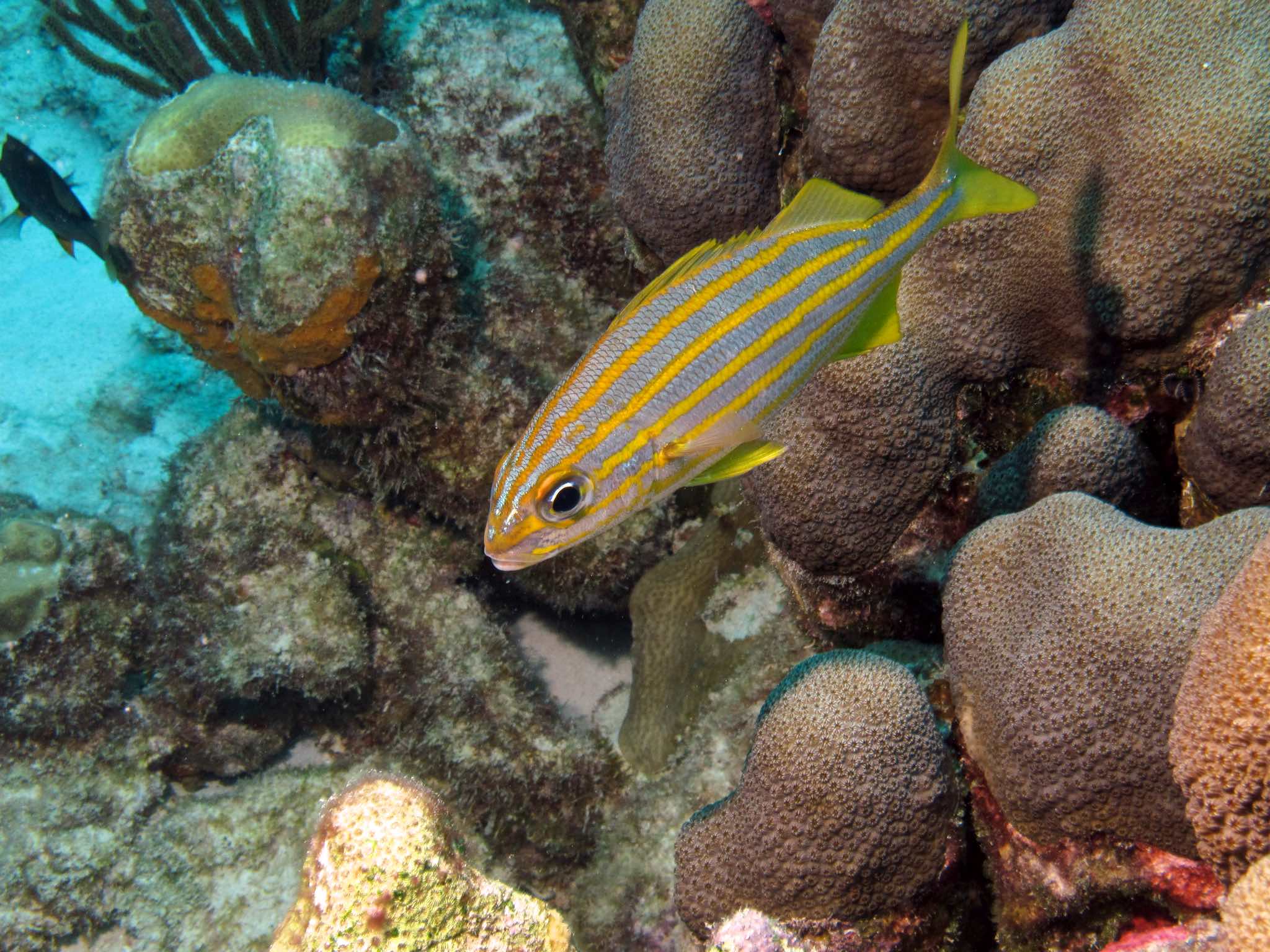
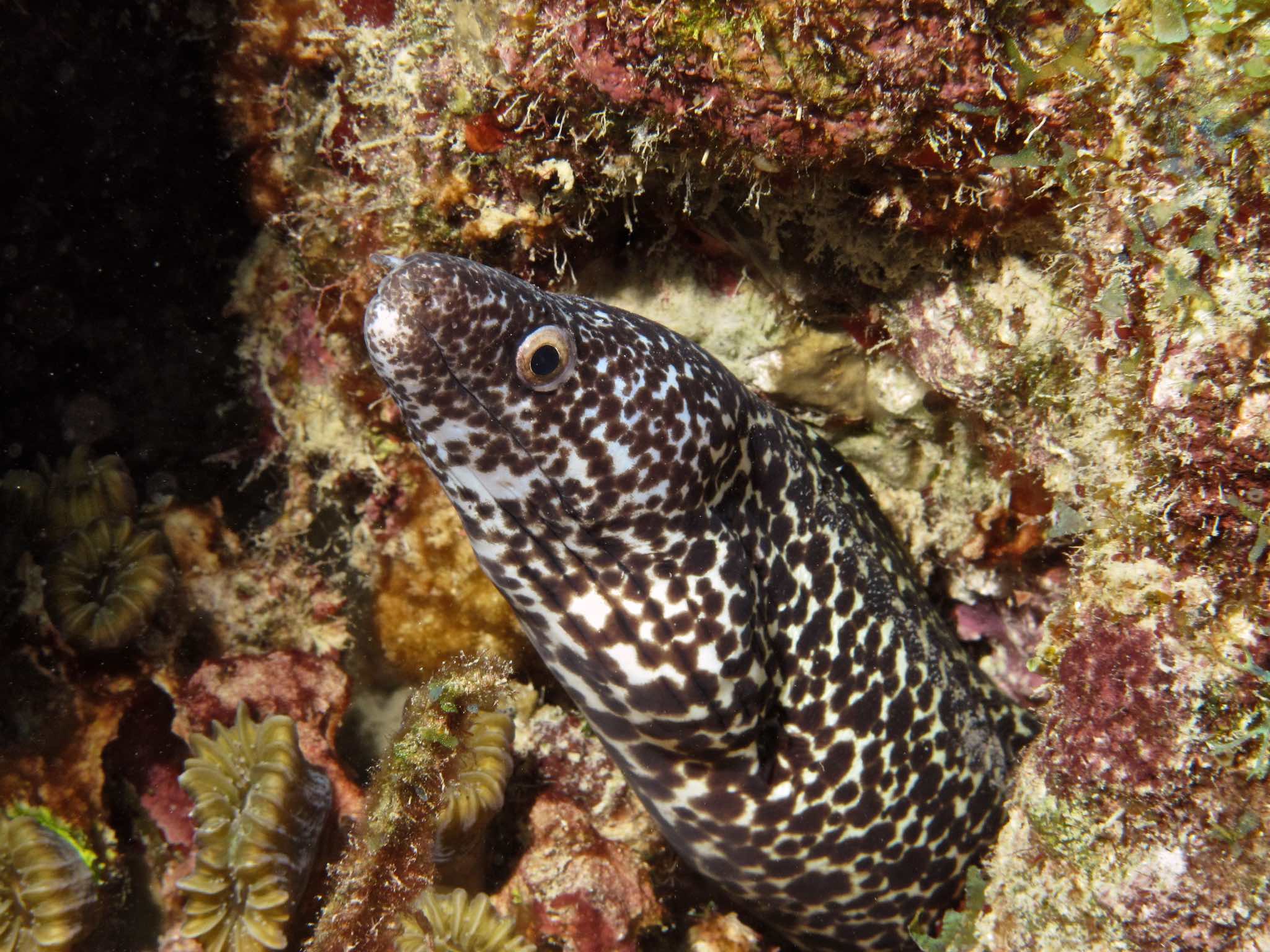
The second dive of the morning was at a beach that used to be called Old Blue, and is now referred to as Tolu, to the north of Oil Slick Leap. It too has a cliff, but it’s only about three feet high, and there’s a notch in it that divers can walk down. At the base of the cliff is a narrow sandy beach. The sand extends out a short way, and then there’s a wall down to the deeper water.
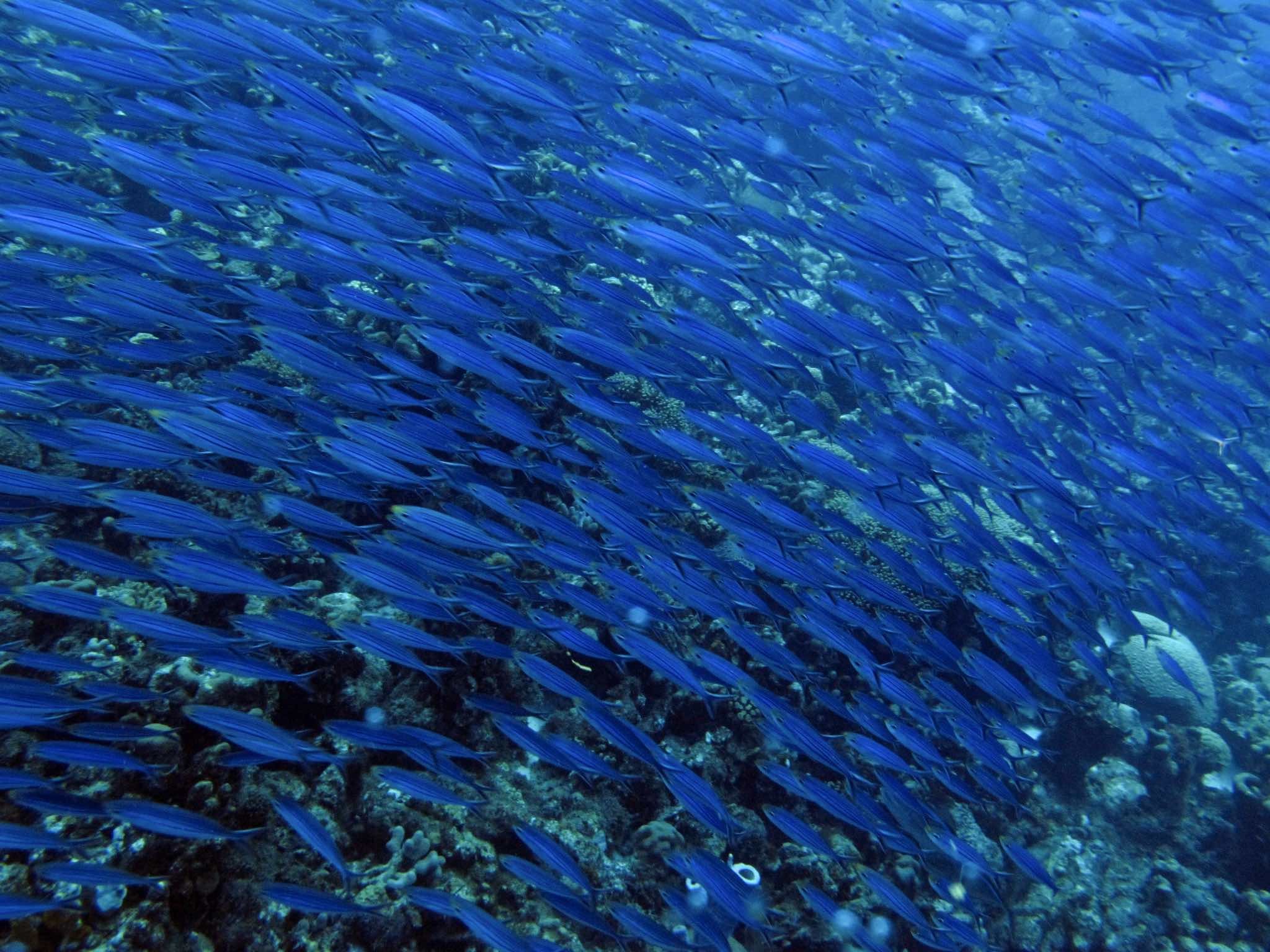
As soon as we got to the wall, we found something special — another bait ball, similar to the one from yesterday, only smaller, and made up of small blue fish, rather than silver fish. We spent quite a bit of time with this bait ball; it was possible to herd it a little. After a little while, they moved away, and I decided not to chase them, and started looking at the other fish. Suddenly the bait ball was back around me again.
There was a lot to see at this site; Henri found an eel out and about, and I saw a lionfish nearby. Just as we were turning around, I saw a damselfish chase a parrotfish out of its algae farm; I actually laughed out loud underwater.
It’s been sprinkling off and on all morning, and the heavens opened up right as we were leaving Old Blue. Paul took us on a scenic tour of the hills at the northern end of the island—cactus lined roads, goats grazing along the sides of the roads, and small shanties. here and there. A very stark contrast with the main town of Kralendijk.
Once we got back to Buddy’s, I had lunch and then spent some time on this post. By 3:30, Henri and I were both ready to get back in the water, so we did a dive off the dock. Buddy’s has a very nice house reef. The southbound longshore current that we’d been experiencing the last couple of dives had abated, so she suggested that we go to the left, ie, to the south. (the resort is on the western shore). It was a very nice dive. The fish were out in droves, and it seemed to be mealtime. I saw lots of black barred sergeant fish (I think that’s the name) lots of jacks, and a moray eel. During the dive, I experimented a bit trying to balance the strobe with ambient light, with mixed results.
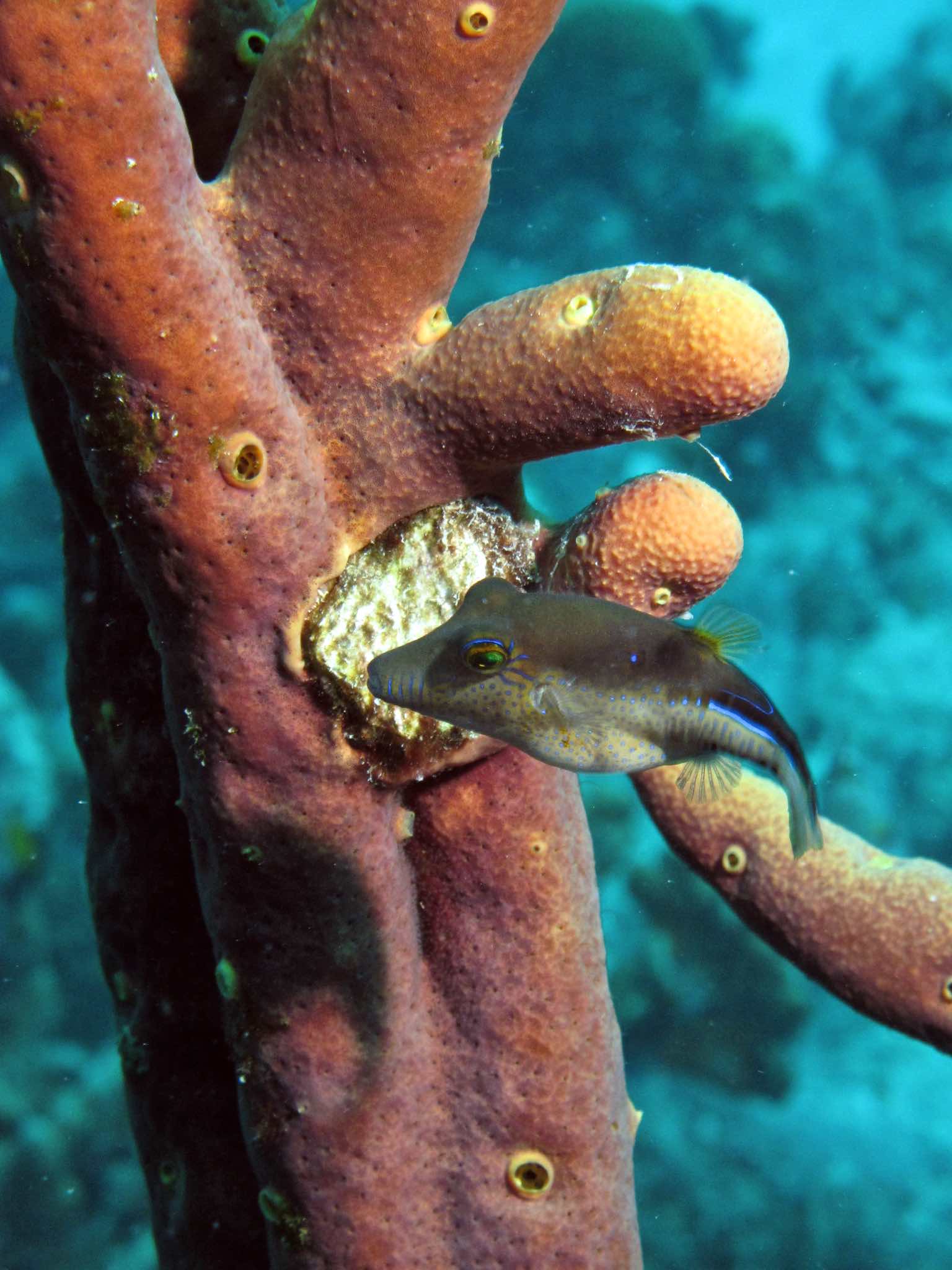
I realized during this dive that I’m definitely overweighted. I hit the reef a couple of times today. I think while Henri’s doing a class tomorrow, I may take a couple of pounds of lead off and work on my buoyancy.
Once I finish this post, I’ll be heading over to the place next door to see a slideshow by Dee Scarr. I think we’re scheduled to do our dives with her tomorrow.
Update: More pictures here
I just picked up a replacement for the old Canon Powershot S70 I’ve been using mostly underwater. It’s not really the best time for me to be buying a camera, but I’ve been noticing for a while that the pictures it takes above water have been very unsharp, and I want something I can trust in Bonaire. I bought it off of eBay for about $200, and repairing it is probably not cost effective. I’m still getting used to the new camera and haven’t even taken the housing out of the box yet.
Most of the major functions, at least, most of the ones that I care about, I was able to figure out just by noodling around with it. But it’s definitely a good example of both the good and bad sides of Japanese design. After using the iPhone and iPad, it’s really noticeable.
On the pro side, the picture quality is very good, and the camera feels solid. Because it’s a prosumer camera, there are separate dials for exposure compensation, shooting mode and ISO. On the con side, I would quibble with the placement of some of the controls — the zoom lever feels awkward to me, for example.
A bigger problem is that it feels like there are a lot of features and modes that are there to be a checkmark on a feature list, not to be useful. This thing actually has a mode to automatically shoot when it detects a smile, for example. I am not making it up, it really does. But to put it in that mode, you have to set the mode dial to scene mode, press the function button, scroll through a bunch of shooting modes (to give them credit, it does have help text), press the function button again, then press the DISP button to choose which of the smart shutter mode you want.
I worked my way through the manual (provided as a pdf, not a physical booklet) and there’s a lot of stuff that might look good on a feature comparison chart, but which I can’t see myself using, either because the feature is too cumbersome, or the feature is too esoteric, or provides an effect I don’t care about, or would prefer to do on the computer. There are several special effects settings that fall under this category, such as color replacement, which I would prefer to do as post-processing. And some of the special modes are just head scratchers… a special mode to make your scene look like it’s a miniature? Really??? (Yes, really.)
By way of contrast, the Apple design ethic calls for fewer features, fewer discrete modes, but more polish on the features that are provided. Had Apple designed it, there definitely would be less flexibility, fewer half-assed shooting modes, and those that were implemented wouldn’t need a long series of key presses. They’d probably also get rid of a lot of the physical button in favor of a touch screen… which is probably not so good for a camera which is supposed to be used inside a housing.
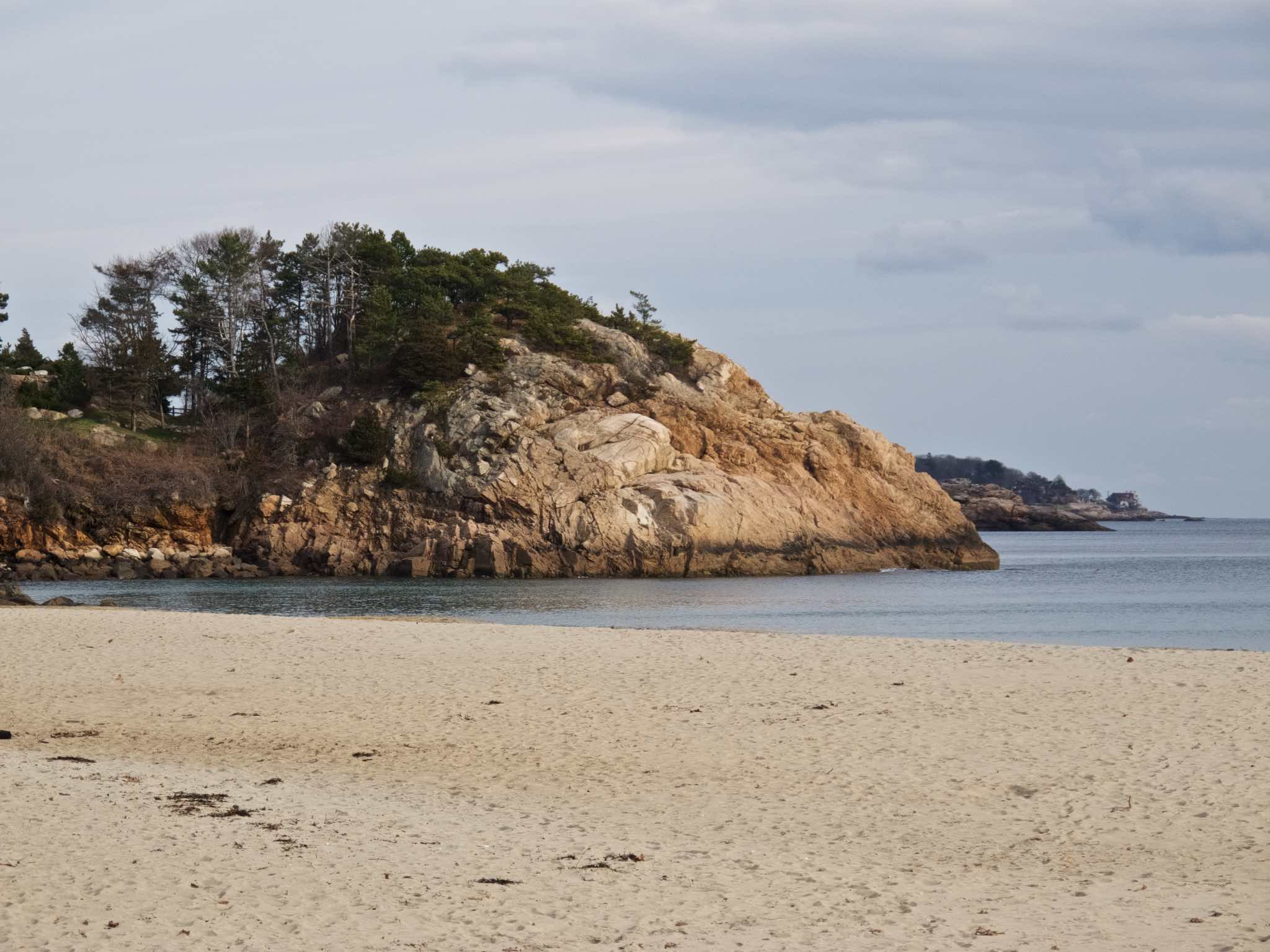
Still, I have to say I’m looking forward to seeing what I can do underwater with this. I took it out for a spin on Saturday up to Cape Ann, and it was very fast, and the picture quality is good:

Singing Beach, Manchester, MA, taken with the Canon PowerShot G12
Opposite side of Singing Beach, Manchester, MA, taken with the Canon PowerShot G 12
The unseasonably warm weather continued today. With a high around 54°, it felt more like October. I took the motorcycle out along Route 109 to 27 to Route 16, past the Weston Ski Track, where they weren’t making snow yet, to Route 30 and back.
I then loaded the bicycle into the car, and took a ride along the Charles. My legs have been stiff and sore lately, so at the start of the ride, I wasn’t sure how far I could ride, but by the time I hit the Mass Ave Bridge, things had loosened up nicely, and I ended up going as far as the North Harvard Street bridge.
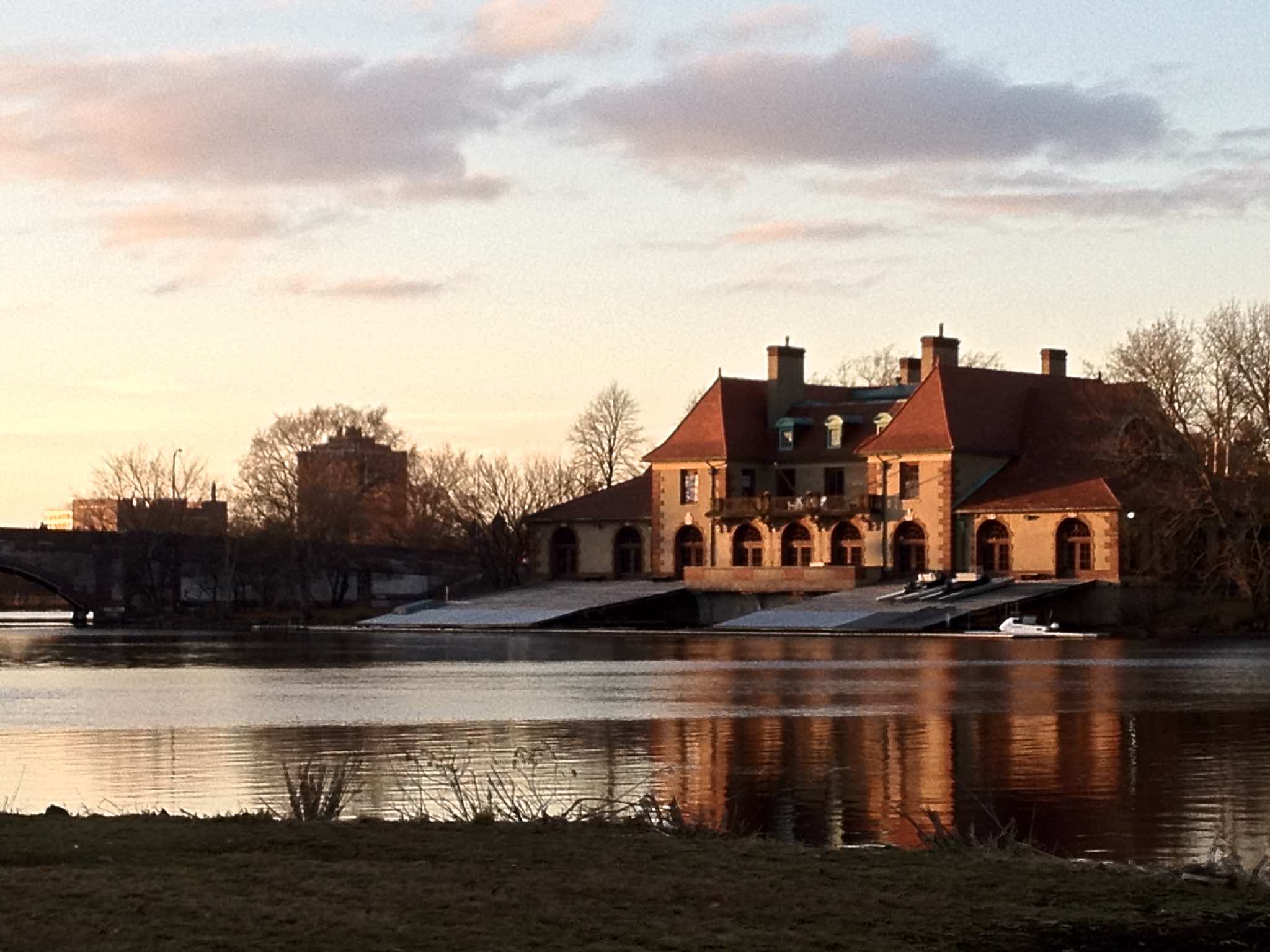 Boathouse on the Cambridge side of the river, taken near sunset
It was beautiful around the river, but the earliness of the sunset was a reminder that it really is December. I’m wondering how long it will be before the weather catches up.

This gallery contains 9 photos.
I put away the the dive gear the weekend the snow came, but with 65 degree weather forecast, when I saw Alex was running a shore dive, I decided to go with it. When I got to the Burger King, … Continue reading
I saw this sign in the front window of Nordstrom’s today. I agree wholeheartedly.

“We won’t be decking our halls until Friday November 25. Why? We just like the idea of celebrating one holiday at a time
Our stores will be closed on Thursday for Thanksgiving festivities. On Friday, our doors will open to ring in the new season in style.”