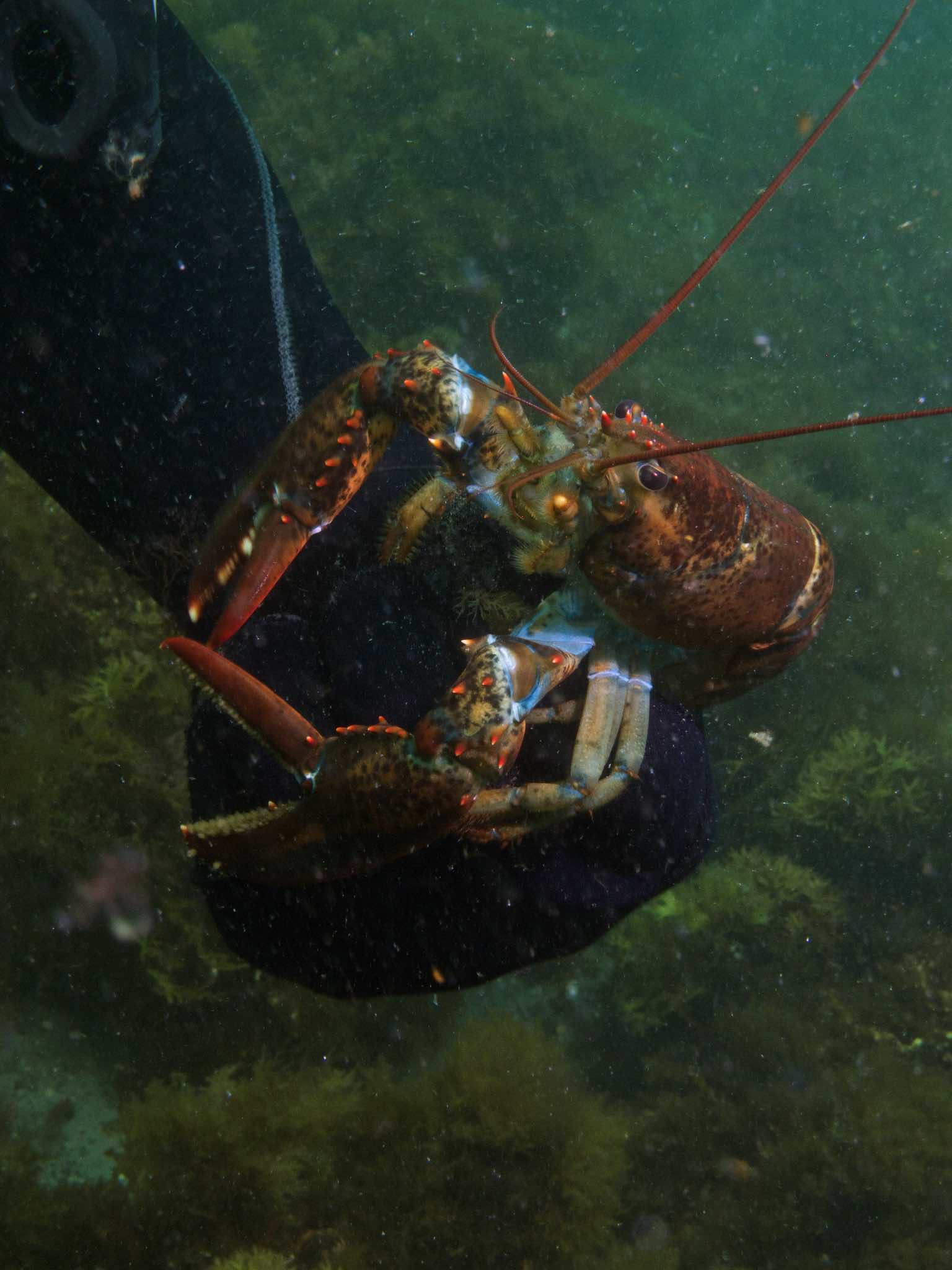
10 Mile Paddle

Gallery

This gallery contains 15 photos.

Sunday, I did Charles River Canoe and Kayak’s Shuttled River Trip from their Nahanton Park location. You meet at Nahanton Park in the morning, and they drop you and the kayaks ten miles upstream, at Charles River Park, a small turnout along Route 135.

The scenery is very nice along the way, and the weather was perfect. Some parts are very wild looking — you’d never know you were close to civilization. In other parts, you’re drifting under bridges and past some very impressive homes. Continue reading

Apple v. Samsung

It didn’t take the jury nearly as long as expected to return a verdict in the Apple/Samsung case. They had a lot of questions to answer, but it didn’t take them long to answer.

One of the most interesting things about the trial has been the publication of many of Apple’s earlier iPhone and iPad prototypes. This is something I’ve been wanting to see for years– it’s always interesting seeing how something has evolved. I’ve long wanted to see how the Aqua user interface used in Mac OSX evolved, prior to its first public release in one of the developer previews.

More importantly though, the parade of prototypes showed that Apple had done the work. They clearly showed that the devices hadn’t sprung magically from Steve Job’s brow; there were a lot of false tries and dead ends involved before they converged on the final designs. In addition, the prototypes demonstrated that the final solutions arrived at were not obvious, and they were not just the development of prior art.

If Samsung had been able to show a similar set of prototypes, they could have made a claim for convergent evolution — things that serve the same purpose tend to end up working the same way. They couldn’t; and Apple was able to introduce emails from Samsung discussing their own designs in light of the iPhone design. I think this 1-2 punch of the Apple prototypes and the lack of similar preliminary work was enough to cook Samsung’s goose.

Neil Armstrong

It was a shock to hear that Neil Armstrong died yesterday; it seemed like it was not so long ago that we watched him step out onto the lunar surface.

Of course, it has been a long time. I was nearly ten that Sunday in July; and very much into the space program. I read as much about it as I could, watched all the launches, and of course, there were the models. Dad and I built a model of the Saturn V together, and I’d also built a larger scale model of the three Apollo modules. I clearly remember the Gulf paper model of the lunar module, and I remember ‘flying’ it–with the aid of a string– from the Cape house stairs.

We were on the Cape that Sunday in July for our two weeks. That year, dad had picked up a secondhand mast, and he and my uncles were setting it up as a flagpole.

I remember running into the house around four to watch the coverage of the landing– with Walter Cronkite, of course. This was in the days before cable, and the picture was snowy and staticky. But I remember when they landed.

What I don’t remember noticing–whether it was because I was only nearly ten, or because of the crummy reception, or because Cronkite himself didn’t remark upon it, was what a near run thing it was. They landed with only about 30 seconds worth of fuel left. Armstrong had noticed the computer was taking them down into a field of boulders, and took over manual control of the Eagle to land them safely.

Once Eagle had landed, I went back outside, where Dad was finishing the installation of the flagpole. They’d set the base of it in concrete, and scratched into the wet cement ‘JULY 20 1969 – ON THIS DAY, MAN LANDED ON THE MOON’. The flagpole and inscription are still there.

The original official plan had called for the astronauts to take a nap between landing and doing the moonwalk. But soon, it was announced, they were going to go ahead with the moonwalk sooner — around 10:30. I begged to be able to watch it, but it was past my bed time, and off to bed I had to go (sulking). Soon, though, Dad came back up stairs, and told me I could watch it after all.

Being the Cape, reception was poor. And it took longer than expected for them to completely vent the Lunar Module, and for Armstrong to work his way through the tight front door of the LM. But eventually, we saw his shadowy figure bouncing down the steps of the LM, and onto the the front footpad.


Neil Armstrong was something of an accidental hero; his place as the first man on the moon is partly due to the happenstance of the astronaut rotation, and the influence of previous events, like the Apollo 1 fire, the deaths of the original Gemini 9 prime crew several years before, and changes to the program sequence, like the insertion of the lunar orbital Apollo 8 mission. And unlike the early European explorers, there is no one person responsible of the success of the Apollo missions. Neil Armstrong was simply the most visible (and somewhat reluctant) face of it. And yet, on the last few moments of the descent, it was his skill and levelheadedness that took them to the surface.

He was an intensely private man. His crew mate, Michael Collins, once described the crew of Apollo 11 as “amiable strangers”, communicating only the technicalities needed to get the job done. By way of contrast, his successor on Apollo 12, Pete Conrad, was very much of an extrovert, and insisted on bonding his mission into a “crew-crew”. I sometimes wonder if Armstrong would have preferred to have commanded one of the later missions instead, where the glare of publicity was less, and there was more focus on surface operations. The only exploring Armstrong got to do was a brief one minute run to the edge of a crater, near the end of the space walk.

On the other hand, he was a test pilot, and Apollo 11 was essentially the last of the test missions, where NASA was figuring out how to land a man on the moon. (I still remember the commentary on the fact that when the Eagle landed, they didn’t know exactly where. Later missions were able to land much closer to target).

Its been 43 years since Neil Armstrong landed on the moon, and nearly 40 years since Gene Cernan left it. Cernan’s still the last man on the moon, something that would have been considered shocking back then. Someday, however, someone will go back there, and Cernan will yield his title.

Neil Armstrong, however, will always be first.
Medflight Motorcycle Run

I took part in the 5th Annual Medflight Motorcycle Run today. The run, which benefits the operations of Boston Medflight, started in Canton at noon. This year, the route was different. Instead of going down Bay Road to Easton and Mansfield, we went through Sharon, back roads to Route 27 in Medfield, before looping back via Routes 16 and 135.

I put the iPhone in the map pocket of my tank bag, intending to get a GPS track, but the sun fried it! ( temporarily). Next time, I put something white in the pocket to keep it cool.

When we got back, they had a barbecue, and then the helicopter arrived. It’s amazing how much wind it kicks up. I got a good video of it landing, but it’s only visible in Safari– when I tried to convert it to formats other browsers can read, it cam out upside down. So much for embedding video with the iOS version of WordPress…

East Coast Divers Annual Picnic

Today was the East Coast Divers Annual Picnic at Sandwich Town Beach. They’ve been doing it the first weekend in August for as long as I’ve been diving, and probably before that. For the past several years, it’s been co-hosted by several other dive shops. There were around 200 people there, including a bunch of familiar faces. This year was the last year Paul Adler was hosting; Nick and Alex are taking over the store at the end of September.

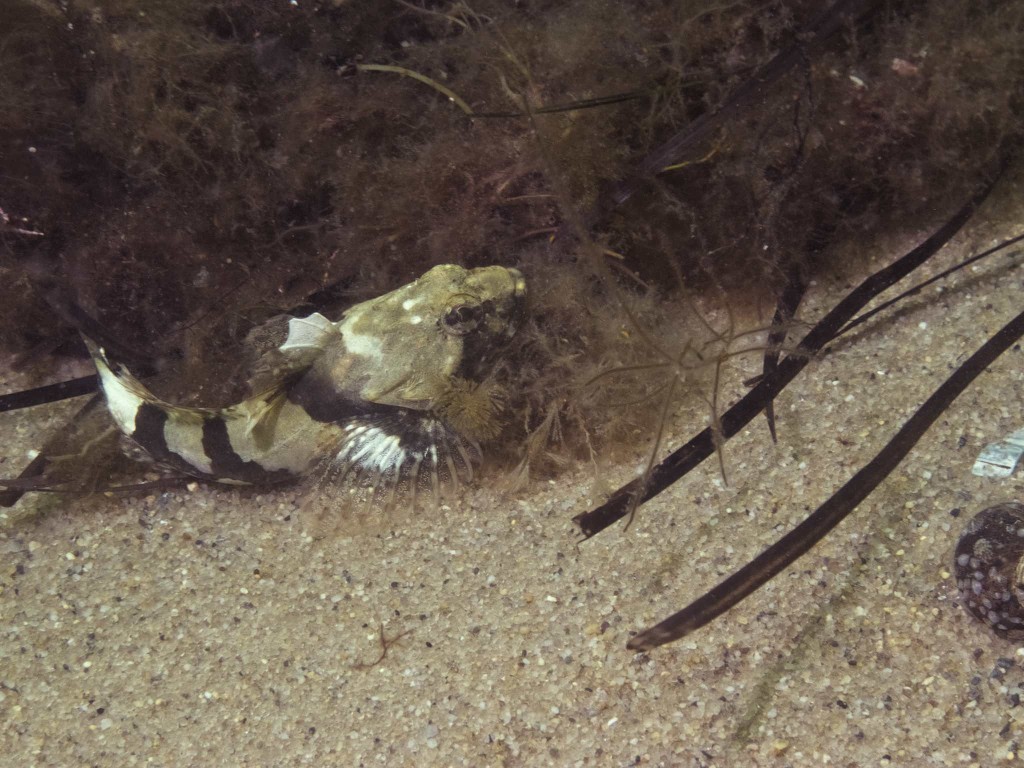
Sandwich Town Beach is a very easy dive site once you have all the gear on the beach.  A lot of people gear up at their cars in the parking lot; I’ve done that myself some years, but this year, with the heat and humidity, I felt it was better to gear up on the beach. It’s a sandy beach, with a gentle slope down to the water. It’s on Cape Cod Bay, near the canal, so there isn’t much surf. Underwater, it’s a mix of sand and clay. The clayey parts are filed with holes and burrows created by the animals there.

This year, I was diving with Henri Menco and JP Falcone, both of whom were on the Bonaire trip with me. Henri did the first dive, and JP did both dives.

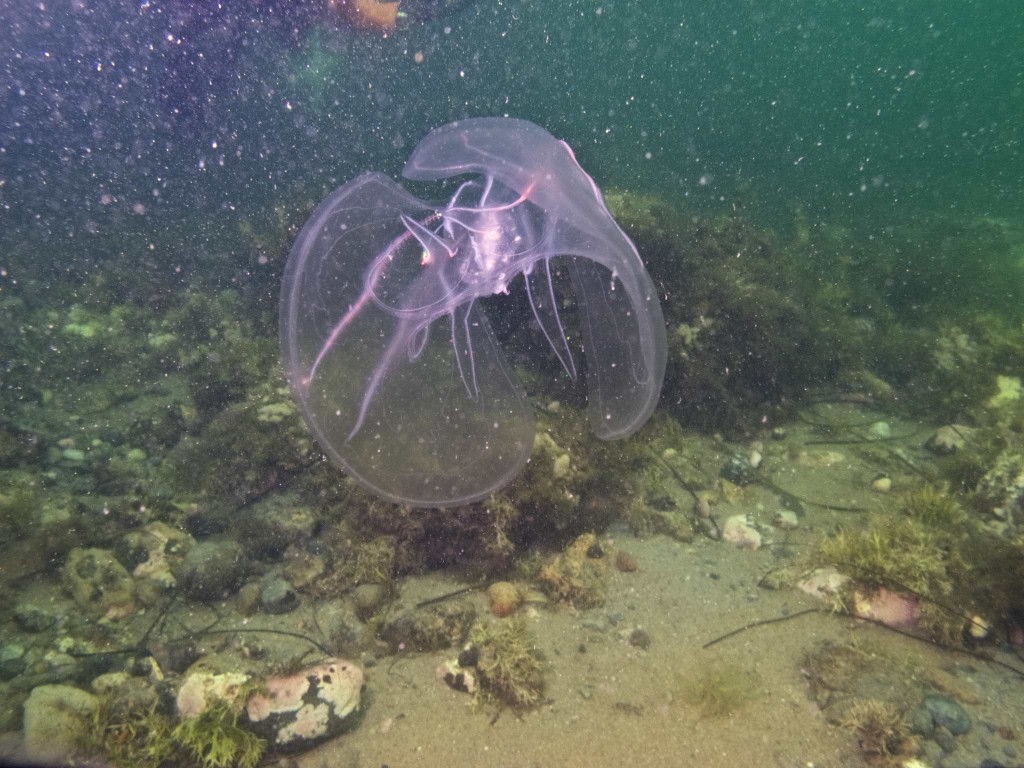
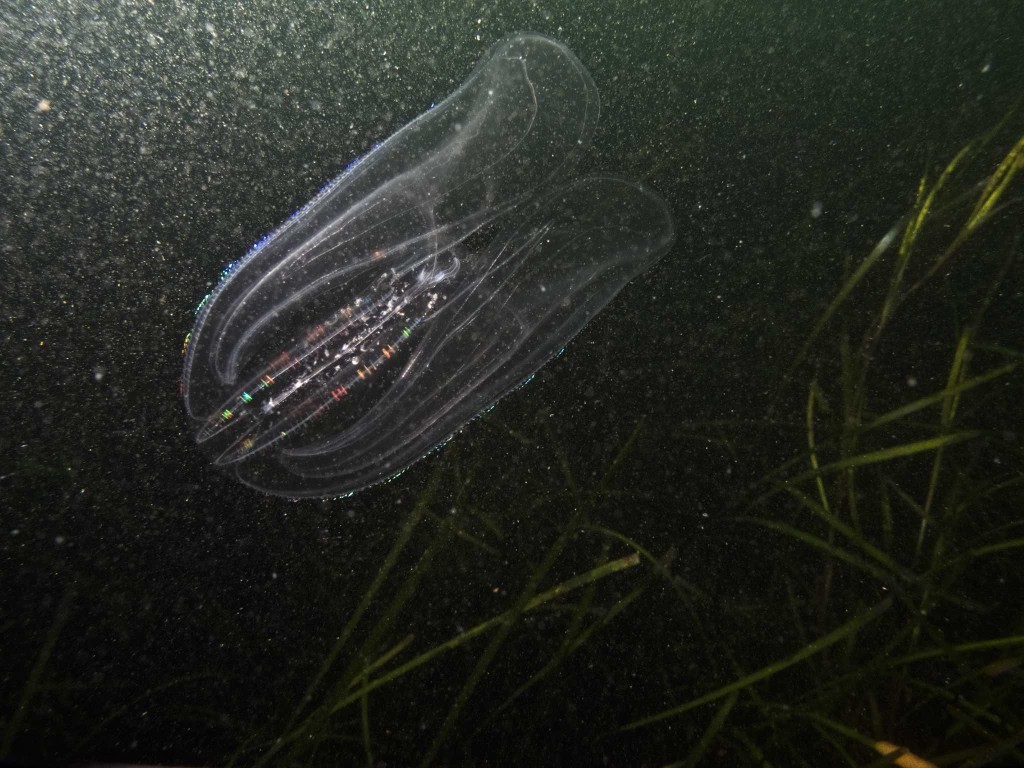
The thing that struck me this year was how many jellyfish were in the water. There were tons of the them; little ones about half the size of your hand. I tried several times to get pictures of them, with mixed success. The best ones, with the strobe pulled in closer to them, have quite a bit of backscatter; the others are too dark.

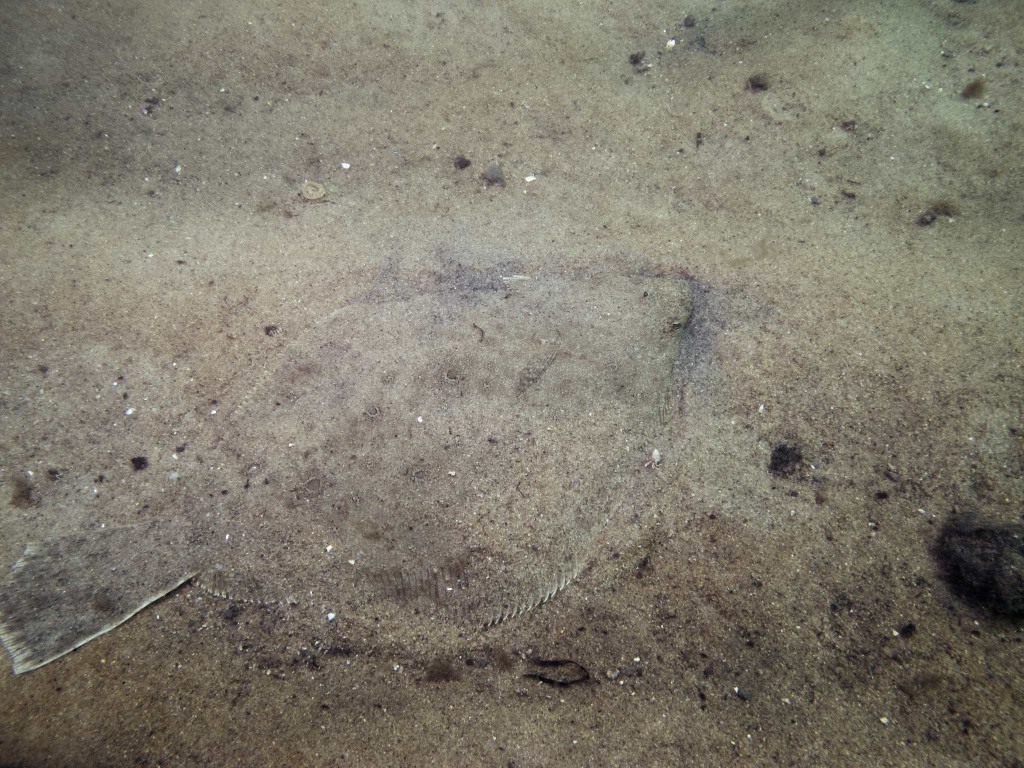
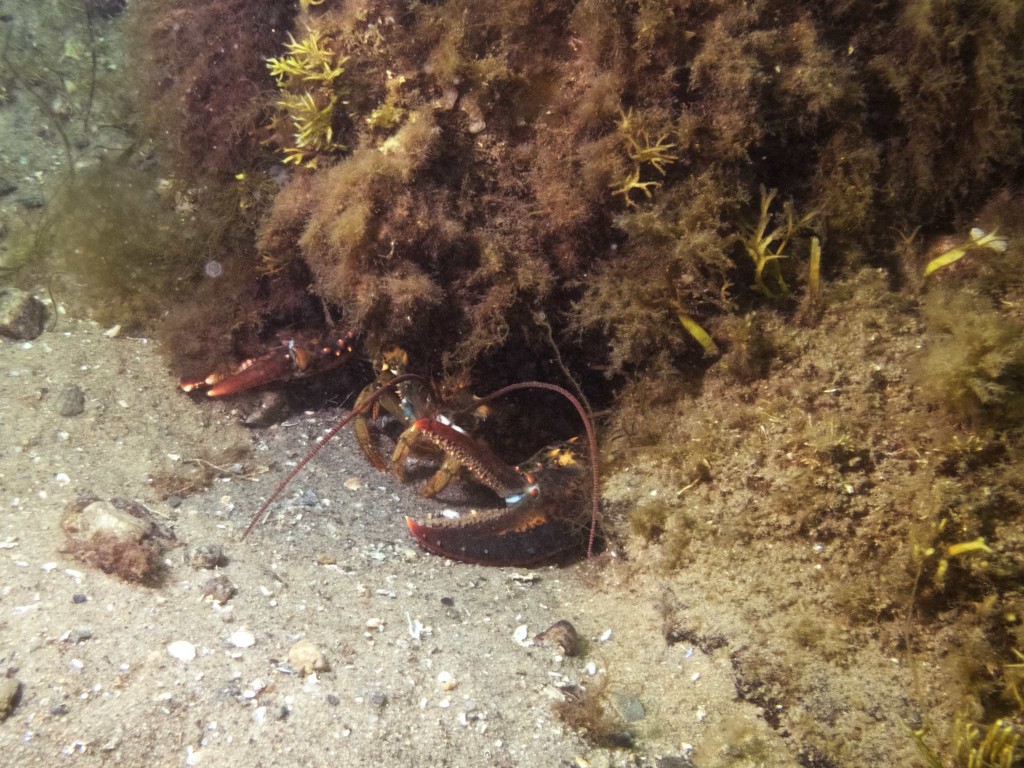
Aside from the jellyfish, there were several flounder, some crabs, and a couple of small lobsters. JP saw a large lobster in a hole in the second dive, but couldn’t get it out.

After the second dive, I did a drift though the tidal creek that runs behind the beach; if you hit the tide right, which I did, the outgoing tide will take you through the marsh. Near the end of the drift, I saw a striped bass right below me.


Distant Lightning

Lightning

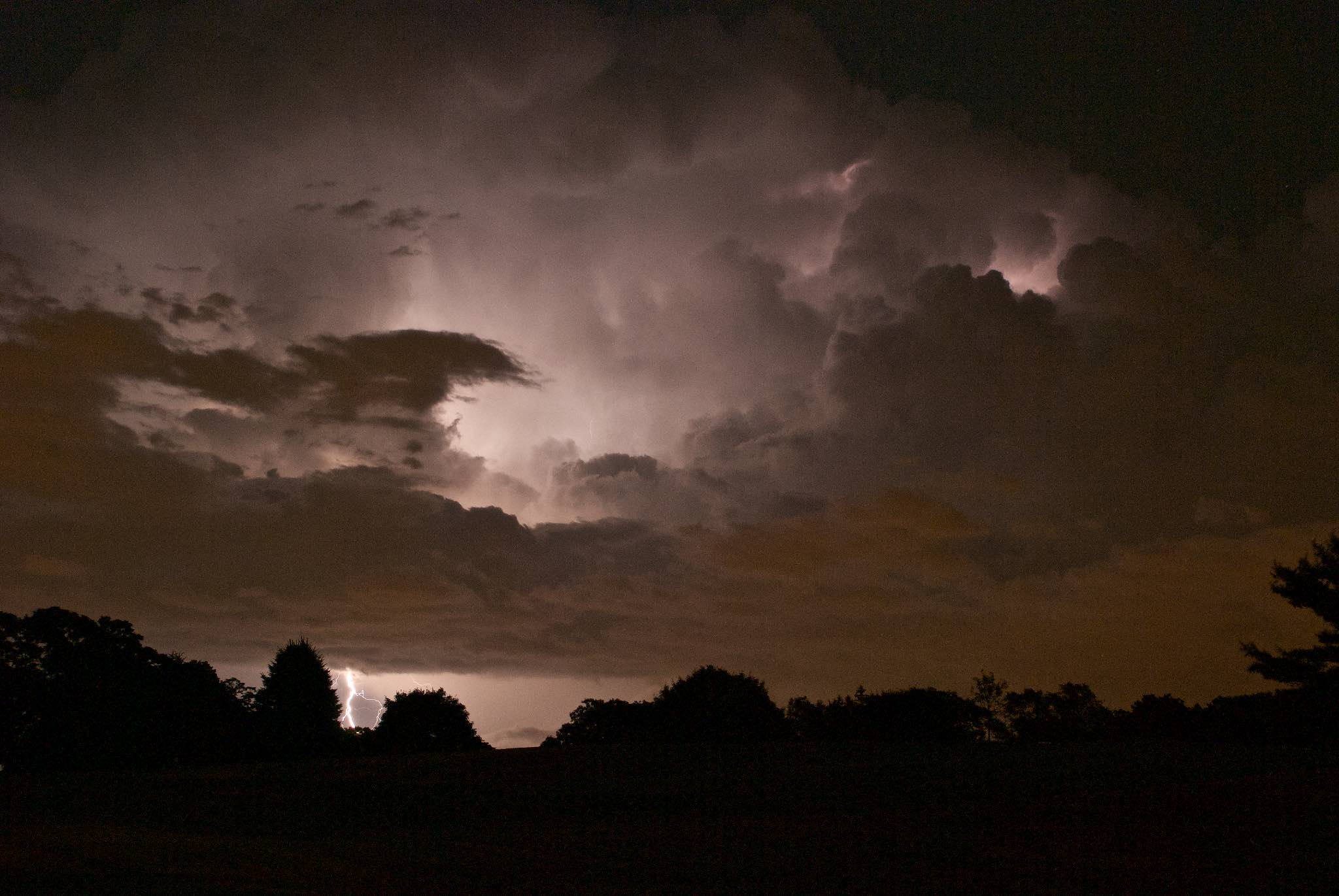
As was riding home from Papa Gino’s tonight, I noticed a lot of strong lightning in the clouds  in front of me. There was no rain, and in fact, it was clear overhead, but there was an almost constant interplay of lightning lighting up a cloud to the southeast. As soon as I got home, I grabbed the camera and tripod, and headed for the golf course for a better view. These are a couple of the pictures I got; the camera was set to manual focus, manual shutter speed of several seconds, and f/9 -10.


Pebble Beach

I did another pair of dives at Pebble Beach yesterday, this time as part of the East Coast Divers shore dive. It was good to see Ken Apple, who was running the dive, again.

For me, Pebble is not a particularly edifying site because you have a fairly long swim over the sand to get to the reefs, and getting into the water over all the cobbles can be hard. It was a little easier the first dive since the tide was low enough that the water’s edge was right at the sand.

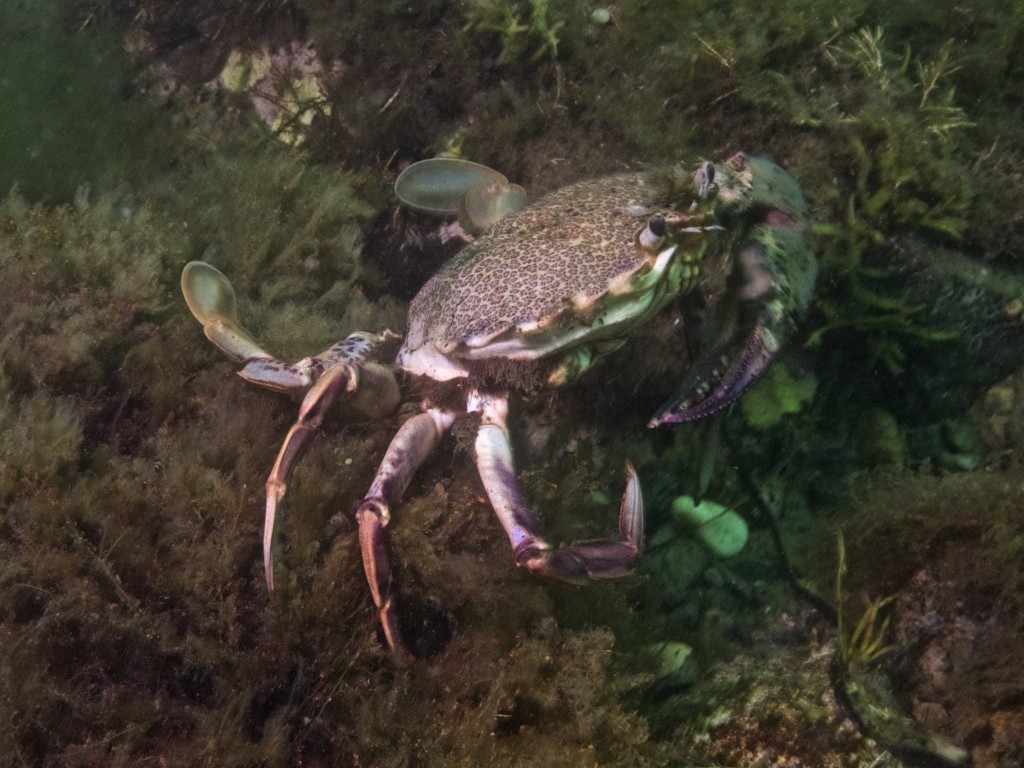
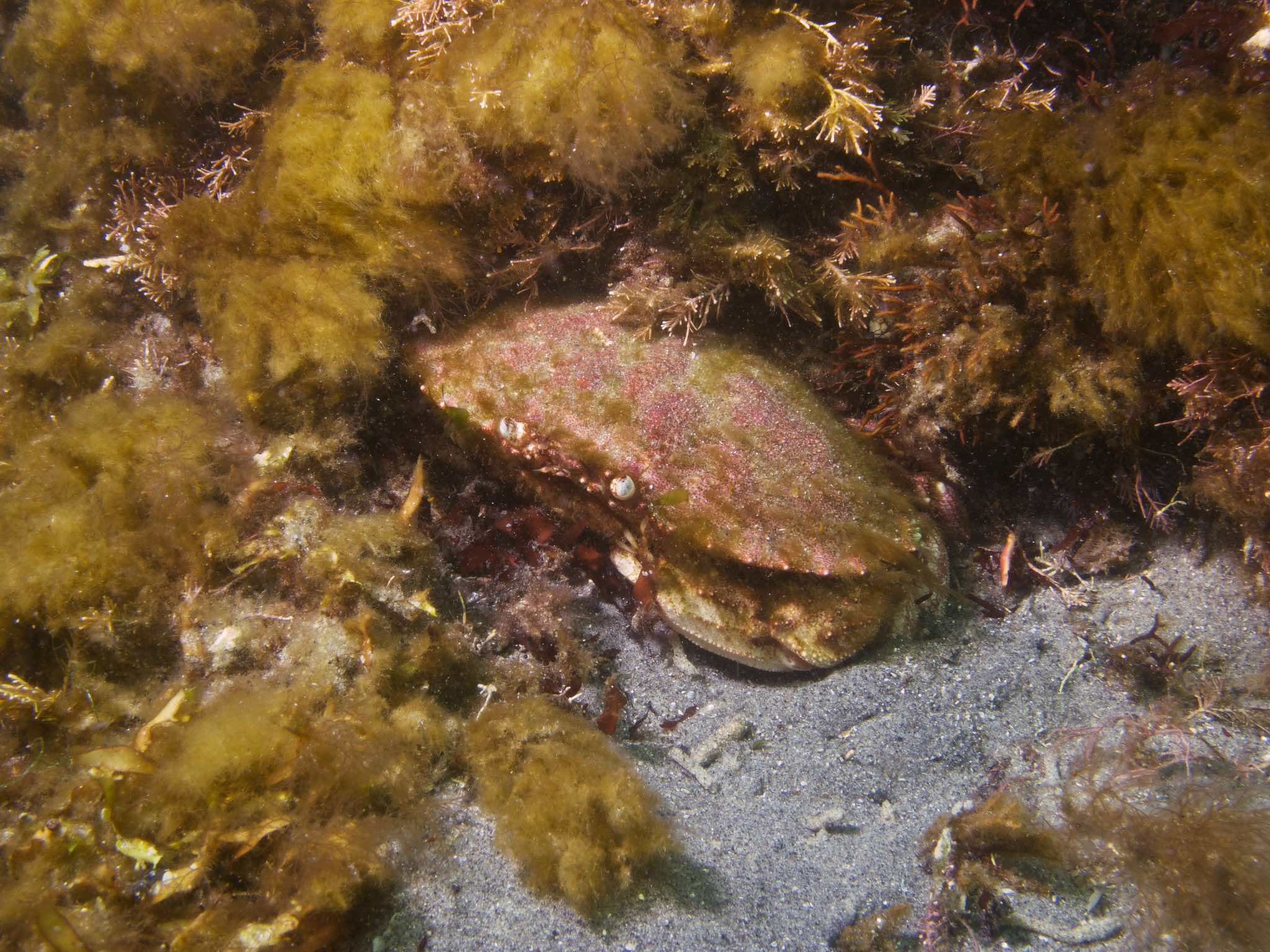
Mostly what we saw was crabs. Lots of crabs, big and small.

Crab

Crab

Crab in the kelp

Crab in the kelp


Sand Collar

Sand Collar

Last week, at Folly, I shot a number of pictures of this thing, which I was vaguely aware was some sort of egg casing. I didn’t know what had made it, so I turned to my friend Ralph Fuller, of Poseidon’s Web, who identified it as a “sand collar”, an egg casing left by moon snails. I was a little surprised, because it doesn’t look at all snail shaped, and because it’s bigger than most moon snails I’ve seen.

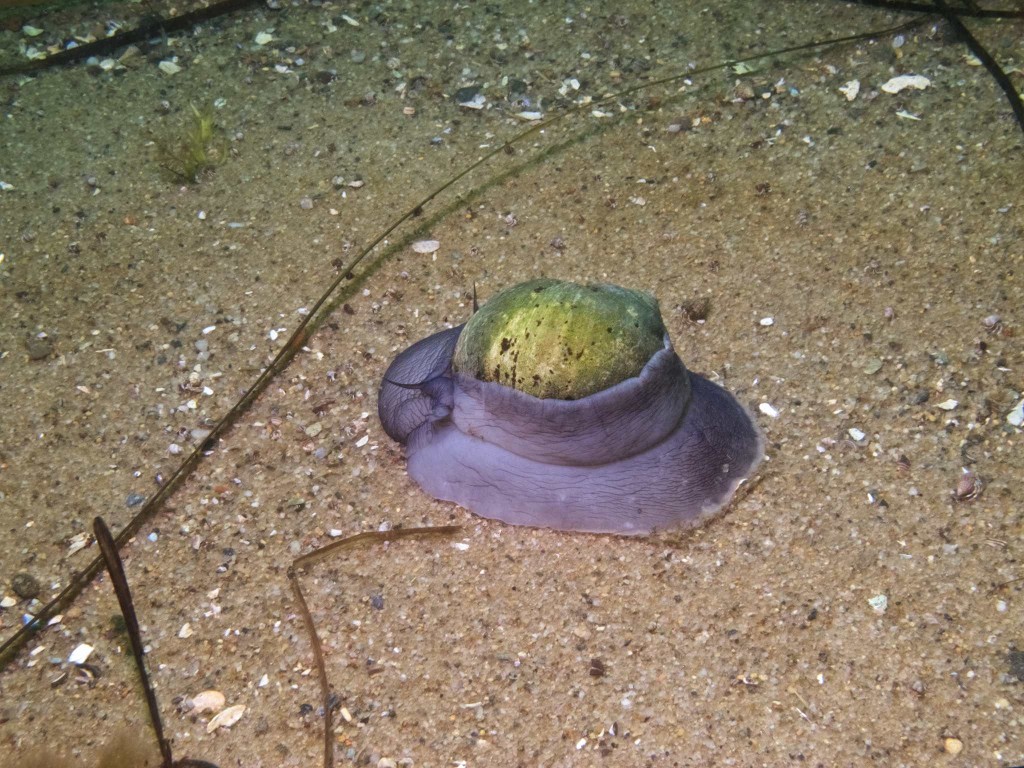
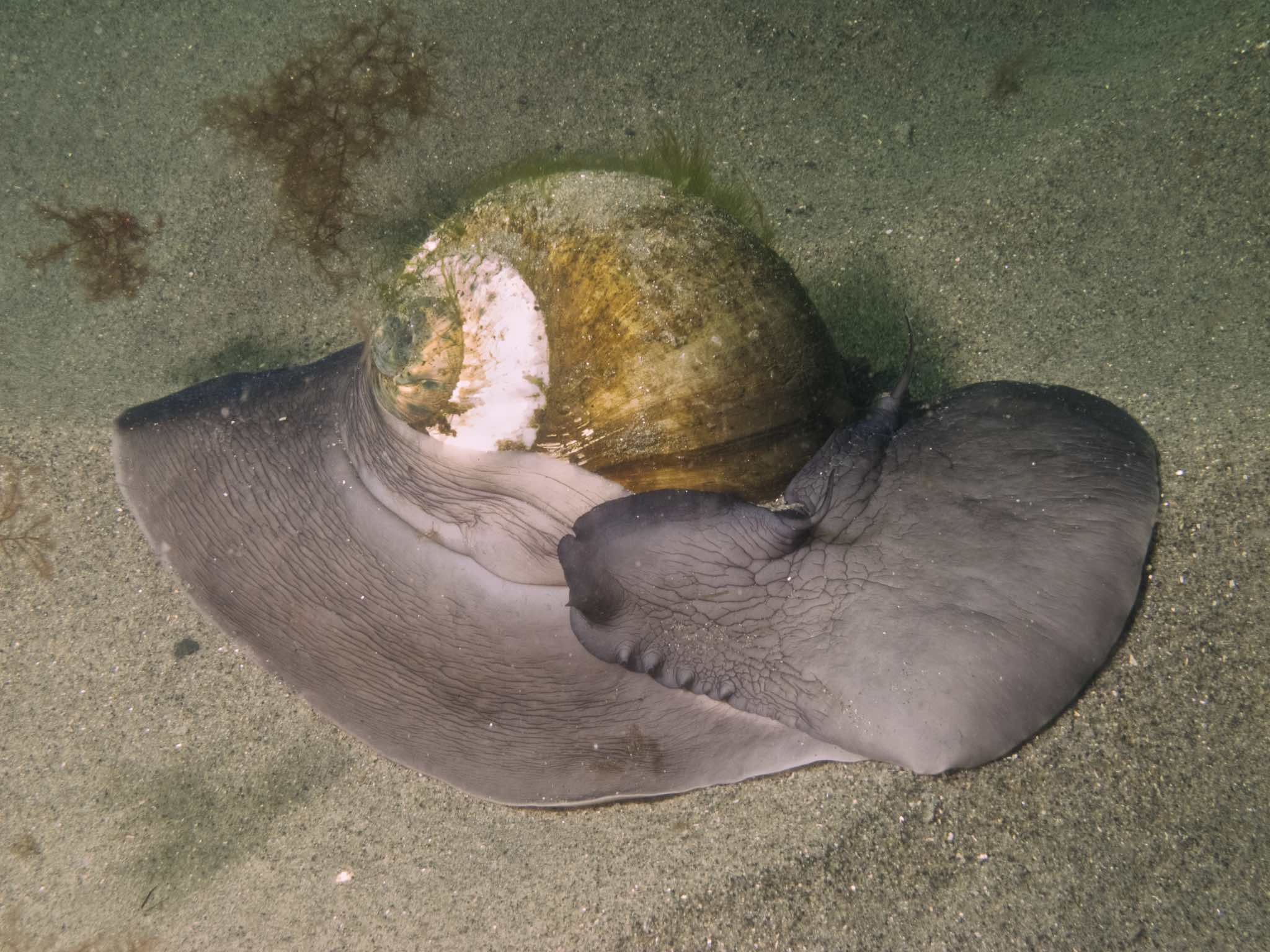
Well, now I’m certainly a believer, because I saw the biggest moon snail I’ve ever seen. It’s very easy to see how it could have created something like that:

Moon Snail

One of the biggest moon snails I’ve seen

I was diving with very new divers; Sam on the first dive, and Sam and Phillip on the second; both were newly certified. On the second dive, Philip managed to startle and grab a small lobster; he made his first lobster catch.

Philip's first catch

Philip’s first catch. (Not a keeper.)

Folly Cove

Gallery

This gallery contains 6 photos.

After several weeks of being out of commission due to a cold and back and shoulder problems, I’m finally able to do stuff on my days off again. Today I did the East Coast Divers shore dive to Folly Cove. The first dive was on the left hand side. The left side of Folly is a steep rocky cliff; and there used to be tons of anemones there. Then one year, there were none. Today, I finally saw a few today; the first ones I’ve seen at Folly in a long time. Continue reading

One More Balloon Picture

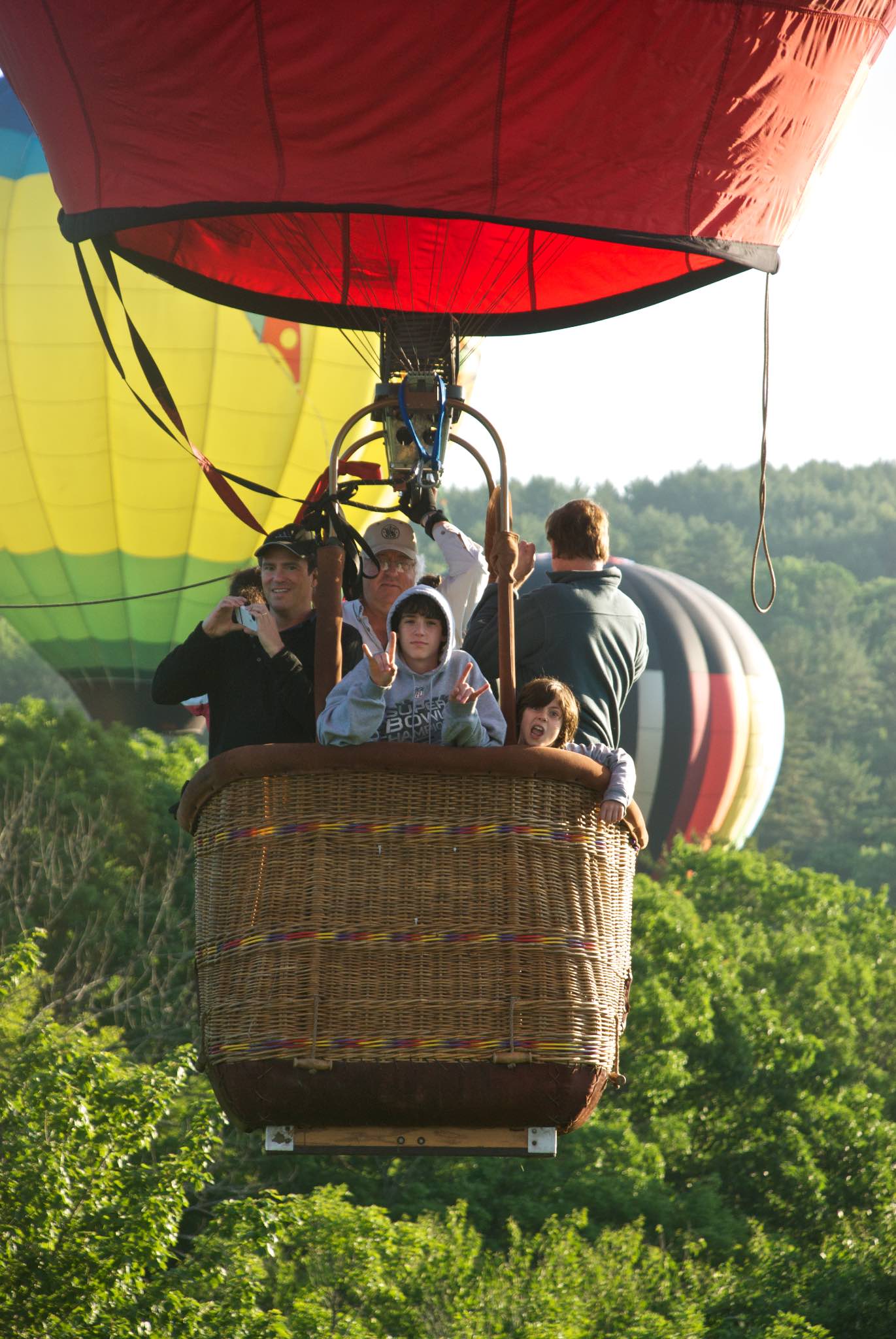
People in a hot air balloon,

Passengers in the balloon behind us

I don’t know who these folks are, but they were in the balloon behind us, and I figured I’d post it on the off chance that they or someone who knows them would spot it.

Comments on WordPress Image Pages, Revisited

Back in January, I posted a solution to a the problem of comment forms on image attachment pages remaining available even after comments on the parent post had closed, based on a solution by Anthony Hortin, of Maddison Designs. I was getting spam from the images on my first gallery page.

The solution I posted back then was to make the include of comments_template() conditional on the parent post’s comments being open. This worked, I stopped getting comments on old images. The code looked like this:

The original fix:

Change this:
<?php comments_template(); ?>
To this:
<?php if (comments_open($post->post_parent)) {
// Only show the Comments Form if the parent post has comments open
comments_template();
} ?>

Unfortunately, the fix has a side effect: comments posted to an image during the “comments open” period also go away when the comments close. At the beginning of the month I posted a picture of some stuff I saw on the Charles that I couldn’t identify; a nice lady answered me, but her answer vanished when the comments closed.

It turns out the comments_template() function also outputs existing comments, so what you really want to do is still include comments_template(), but somehow, tell it comments are closed.

Fortunately, the function that returns the flag that indicates whether comments are open respects a filter, ‘comments_open’, so it became simply a matter of figuring out how to add that filter.

My first attempts to do so crashed. My function that tried to set the flag was trying to call comment_open() with the parent post, and crashed. Then I tried only applying the filter if the parent post’s comments were closed, using a function that simply returns false. It feels kludgy, but it does work.

The Revised Fix:

Change this:
<?php comments_template(); ?>
To this:
<?php
function close_image_post_comments() {return false;}

if (!comments_open($post->post_parent)) {
/* Only show the Comments Form if the parent post has comments open
by adding a filter to pass false to comments_open() */

add_filter( 'comments_open', 'close_image_post_comments', 10, 2 );
}
comments_template(); //bring in the comment output
?>

This feels a little kludgy to me– I’d rather have the decision making in the function rather than the calling code, but it does work, and at this point, I’m not handy enough with PHP to figure out what I was doing wrong in the earlier version of my function.