I’ve been enjoying Adam Ragusea‘s videos on YouTube for a couple of years, now, and recently saw his two part video, Growing Bread (Part I, Planting to Harvest, and Part II, Harvest to Oven), wherein he grew a small plot of wheat in his garden, then harvested it, threshed it, winnowed it, ground it into flour and baked it.
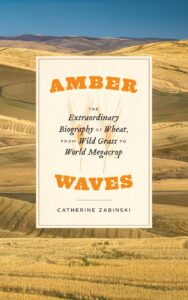
Along the way, he discussed the history of wheat, much of which was drawn from Dr. Catherine Zabinski’s Amber Waves, The Extraordinary Biography of Wheat, and included clips of an interview with Dr. Zabinski. It was fascinating, and interesting enough that I decided to buy the book. I just finished the book, and I’m glad I read it.
In the book, which she bills as a “biography” of wheat, Dr. Zabinski covers the history of the plant, starting way way back with the start of photosynthesis, to the development of cell walls, which allowed plants to have structure, to how our ancestors found a particular grass growing in the Middle East, and realized that its seeds were edible. From there she talks about the numerous “environmental sieves” — natural and human selection — that shaped wheat into the megacrop it is today.
For example, the earliest wild wheats, called einkorn, had seed tassles that tended to shatter when ripe, scattering the seeds on the ground where they would plant themselves. Along the way, there was a mutation that caused the seed heads not to shatter. This is not so good for the plant, as the seeds don’t hit the ground, but it also made the seeds easier to harvest, so the humans of that era tended to pick those seeds, and replant them, propagating that trait.
She also gets into the genetics of wheat. The bread wheat we grow today is the result of two natural hybridization events. In the first, wild einkorn hybridized with goatgrass, creating a variety of wheat called emmer. And then later, emmer hybridized again with goatgrass, creating a plant that produced seeds that were bigger and had softer husks, which were more easily removed — essentially, easier to prepare as food. From this natural hybridization, humans selected again and again — picking varieties that grew better under cultivation, or produced bigger fruit, or, as humans carried it all over the world, selected varieties that grew better under local conditions.
Dr. Zabinski discusses all of this, both from a cultural standpoint of how humans spread the crop and domesticated it, and from a biochemical standpoint, explaining in fairly easy to understand language how DNA works, how genetics work, how mutations occur, and how mutations and having a large genome to draw on, courtesy of the extra chromosomes the hybridization events that created bread wheat, allows for the necessary genetic variety that allows evolution to refashion the plant in ways that make it a viable crop in a variety of different environments.
From there she discusses how agriculture shaped human civilization — up until recently, it took a lot of work to harvest a crop, and governments and social structures grew up to mediate that need for labor and the distribution of food, and winds up with the developments of the twentieth century: mechanized agriculture, and the rise of plant breeders specifically trying to develop varieties with specific features, such as disease resistance, or shorter stems to reduce the risk of the plants flopping over, making them harder to harvest. This was the so-called Green Revolution, and she makes the point that part of the impetus for the Green Revolution was to combat the Red Revolution of Communism. She does discuss some of the downsides of the Green Revolution — the dangers of a plant monoculture lacking the genetic variety to cope with changes in the environment, and the ecological damage that agricultural practice can inflict, but she’s an optimist, and ends the book with a description of efforts to create a perennial variety of wheat by crossing it with wheatgrass; the advantage of a perennial vs an annual crop is that it’s less environmentally damaging.
Through it all, the book is clear, engaging, and easy to understand. I was a little concerned that it would be a dry, academic text, but it isn’t. She steers clear of jargon, and when she does introduce specialized terms, explains them well, and keeps her story moving. I read it on my iPhone and it’s the first book I’ve read start to finish in months.