It’s hard to believe we’re already over a quarter of the way into the twenty-first century. We’re not even in a transitional period anymore.
I spent the first part of yesterday holding down the fort while a plumber fixed a very small leak coming from under the toilet. It turned out that when the previous owners re-tiled the bathroom, they didn’t raise the toilet flange. My guess is they used a lot of sealant and hoped it would hold, but I’ve been noticing mold growing in the grout lines of the floor — just a little bit a leakage; so small that I wasn’t even sure it was wet there.
After the plumber left, I went into Boston for First Night. It was such a shadow of what it used to be. I saw an organ concert at the Christian Science Church, then went up to Government Center to see the ice sculptures (such as they were), then watched the parade, and headed down to the Common for the fireworks. That, at least, was great. From there, I headed Old South Church for the Pipes and Pops concert. I was surprised when their opening number was the theme from Star Trek: The Next Generation. After that, I headed home to enjoy one last night with my Christmas tree.
We got about 3 inches of fluff overnight. I headed out to breakfast, then cleared off the walks and back deck. I discovered I really need to learn how to engage the Jeep’s four wheel drive, as the rear-wheel drive doesn’t do well in the snow. Now, I’m making this post and about to take the site out of Christmas mode, and then it’s time to take down the tree, which I’m finding myself reluctant to do, partly because it’s a lot of work, and partly because it’s been a nice tree. But it’s time.
I really don’t have any great plans for this year, just a couple of things I’ve been thinking about. I’d like to exercise more, so that diving is feasible this year. I’d like to ride the motorcycle more, so that I can finally start taking longer trips. I’d like to do a winter trip on The Mountaineer, and I’ve been vaguely thinking about trips back to the UK or Bonaire, but nothing concrete yet.
Update 11:!5 PM
It took me all afternoon to strip the tree, clean up the living room and get the tree out, but it’s done. It was a great tree, but over the past week or so, it hadn’t been taking up much water, and it was pretty dry. There were needles (and tinsel) all over the place. I ended up throwing away three of the old strings of lights I brought over from the old house, plus some old decorations.
Also, I had a quick read of the relevant section of the Jeep manual, and found that the drive mode lever was just a bit stiff, and needed a little more force. I ran a quick errand this afternoon, and was able to shift it into 4WD Hi and then back to 2WD.
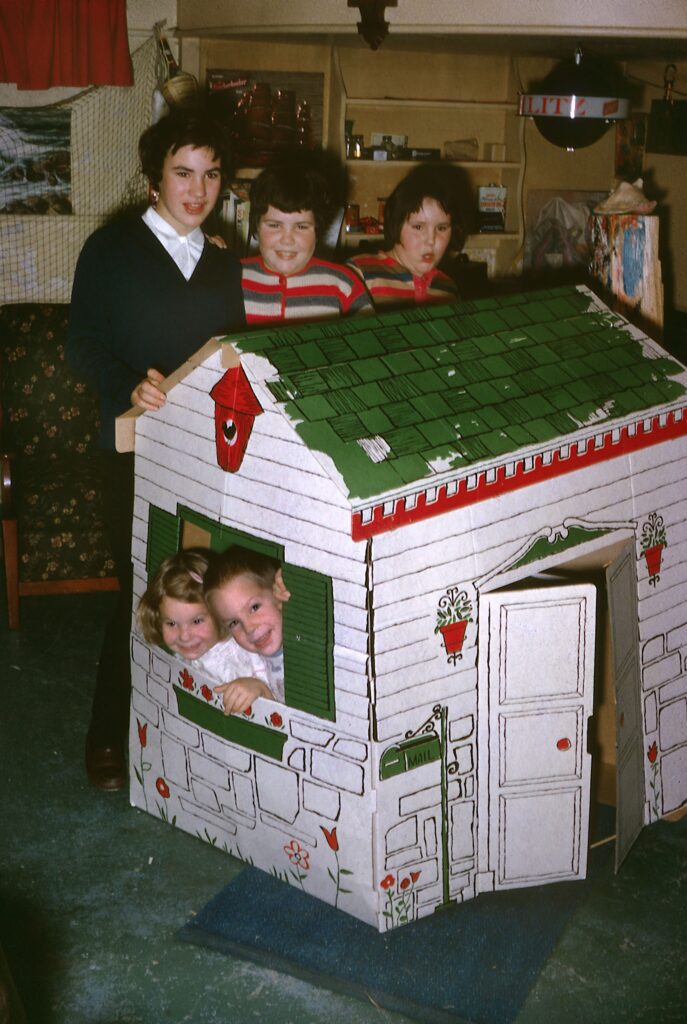
My cousin Susan was the first grandchild in the family; the daughter of my Uncle Billy and my Aunt Dot. Billy died young, leaving Dot a widow with three young daughters.
It seemed for a while like the three of them were around a lot; my Dad became a surrogate father for them before he married, and even afterwards, we saw a lot of them when we visited my grandmother, and they came fairly often to the house. I remember her staying over one summer evening and sleeping out on the cot on the porch, and distantly remember, perhaps aided by photographs, of being with them on the Cape, and seeing a shipwreck buried in the sand.
Susan and her sisters at our house, behind a toy house with my sister and I in it.Susan and her sisters with us
All three girls were older than me, with Susan being very much older, there being about eight years between us, which is an eternity when you’re six.
This Christmastime marks the 60th anniversary of her death. All three girls were fond of horses, but in December of 1965, Susan was either thrown from or fell off her horse. At first she shrugged it off, but after a few hours, her mother noticed was something seriously wrong, and got her to the hospital.
I don’t know the exact details of her injury, whether it was a bad concussion or whether a skull fracture was involved. I do know she lingered, I believe in a coma, over the Christmas holiday while the whole family held its breath and prayed for her.
My mother often told us the story at Christmas of how she went to Midnight Mass that year, and started sobbing uncontrollably when the children’s choir started singing, to the extent that her father had to hold her tight.
Susan finally died December 28, The Feast of the Holy Innocents in the Catholic calendar. She was just 14, Dot was devastated of course, and her death created an additional hole in the extended O’Hara family; what once had been a threesome was now two, with one member always missing. And of the over two dozen cousins of my generation, only a few of us are old enough to remember her; I’m the only one of my own siblings old enough to remember her, and most of my cousins are younger, But those of us who do, remember her fondly.
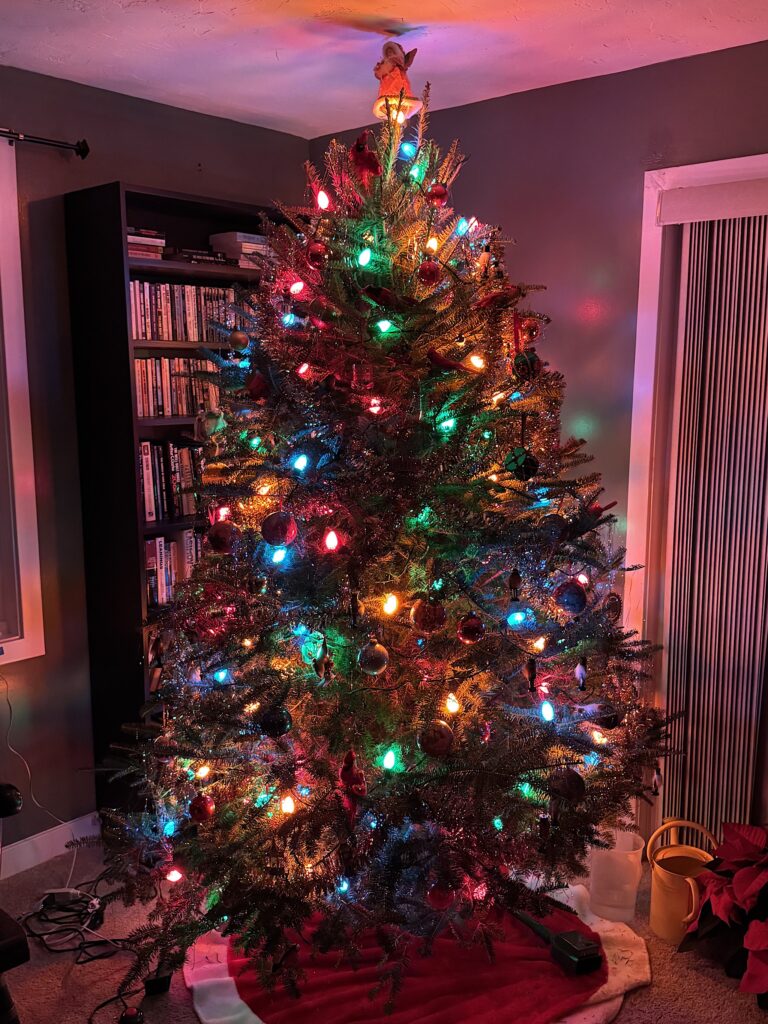
Thirteen years ago, in Season of Lights, I mentioned that the then-new light emitting diode (LED) Christmas lights were not to my taste – “the newer LED lights seem to be too heavy on the blues. Their blue lamps are quite bright, and their oranges and reds less bright in comparison” Alec Watson of the Technology Connections YouTube channel felt the same way; for the better part of the last decade he has published videos complaining about spectral colored Christmas lights and how he has tried to reproduce the look of older lights.
Personally, I don’t object to the brilliant blues the way Watson does; I think the problem with first generation LED lights (which unfortunately are still around) is that the red and orange lights are deficient. They’re nowhere near as bright as the blue or green lights, and so the string as a whole feels unbalanced. Over the past couple of years, I’ve seen lights, which, while they still have the tell-tale brilliant LED blues, have orange and red (and white and sometimes purple) lights which are bright enough to balance the blues. I just got back from a drive around Boston Common, and am happy to say that the official Boston Christmas tree is lit this way, and there are several houses nearby that also use these better-balanced light strings.
Even better, there are now LED light bulbs expressly designed to emulate the warm look of incandescent lights. A couple of years ago, Technology Connections did a video about the new Tru-Tone bulbs. He was positively giddy about them. I was interested, but they were sold out last year.
I was still interested this year, so this October I decided to buy them before they sold out. I bit the bullet and ordered five 25 C-7 bulb strings and enough lights to fill them. I chose not to order the complete sets, as I don’t care for white bulbs mixed with colors. I was really hesitant because they’re really pricey, but dammit, they do look just like the Christmas lights I grew up with, but without the heat or electrical demand. So here I sit, next to my tree, basking in the warm glow of its lights.
Unlike last year, I didn’t have a pre-conceived idea of what this year’s Christmas Card would be. I generally start scanning my photo library around Thanksgiving, but the cupboard was coming up bare. I started to think maybe I’d go into Boston over the weekend after Thanksgiving to see if I could take a picture of lights that spoke to me.
And then I went to Polillio’s in Stoughton to pick up a wreath and kissing ball for the front door and steps. They’re a garden center that I used to use a lot before I moved to the condo, and they always have a lot of Christmas decorations on display around this time of year, so I had my eyes out for something I could photograph.
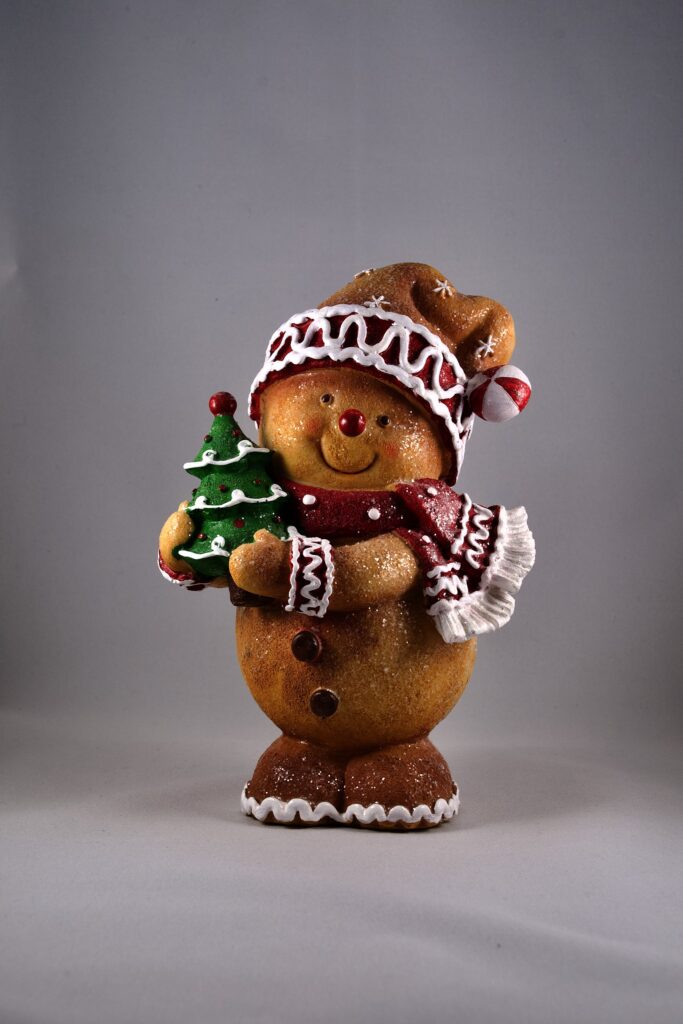
And then I saw it — a ceramic figurine of a teddy bear in a Santa hat holding a Christmas tree. It was cute, and I figured “A picture of a teddy bear from Ted… why not?” So I picked it up, and set up the table top studio.
The “studio” was a Christmas present from my mother from about a decade ago. It’s a small lightbox about 16 inches cubed, with a pair of lights. It came with white, red, blue and black backgrounds that attach to the back of the lightbox with velcro. I first used it for my 2016 card of the snowglobe. It almost didn’t make the move here, because I’d broken one of the lamps while shooting my 2021 gingerbread house card and hadn’t been able to find an exact replacement bulb. I was originally going to toss it when we cleaned out the old house, but in the end, I brought it over, and I decided to replace the broken halogen bulb and its remaining twin with an LED bulb that turned out to be both brighter and less hot. It was rated as a 5000°K bulb, and the color temperature turned out to be pretty reasonable, and easily adjusted in Photos.
I set the studio up in the dining area, and put the teddy bear in it. I decided to try shots with the white, red, and black backgrounds. For the first set of pictures, I tried all three of my lenses. I knew I wanted to shoot it from the bear’s eye level, and originally envisioned it as a full length picture with open space all around it, and some extra space above for the text. I shot 28 variations, against white, red, then black, and then transferred the results to the computer for a look.
Re-creation of studio set-up
I frankly wasn’t thrilled with any of them. The composition was a little too on the nose. I did decide that I liked the red background, and since I knew I’d just picked up ink, I could afford to print a picture with a lot of red. On the other hand, I didn’t care for the composition of any of the red pictures.
The very last picture I shot, though, had possibilities. I was shooting against the black background, and since I knew I probably wasn’t going to use it, I was a little freer with the composition. I came in tighter, and framed him mid torso up. I didn’t care for the background, but I did like the composition. So I decided to shoot another batch.
Since I had a better idea of how I was going to frame them, I switched to my 105mm macro lens. It’s a fixed focus lens, and is sharpest lens I have. I found for this second session that placement of the lights made a difference — the bear is lightly covered in glitter, and the position of the lights controlled how they would catch the light, as well as the play of the highlights and shadows on the bear itself. I shot 11 variations, and they were better, but still a little flat. Also, in several of the pictures, the glitter next to the bear’s left eye was catching the light strangely. I realized the bear was turned so that the side with the Christmas tree was turned slightly away, and that it should be turned so that the tree side was slightly closer, almost as if he were presenting the tree to the viewer. So I shot one more batch, and this time, I got what I was looking for.
I’d done the kind of normal corrections I do for any photo. All my Christmas card photos up to this point had required some sort of Photoshop (or equivalent) work, but when I brought this one into Photoshop, I looked at it and said, “Nope. It’s fine”. This was the first time; all the work was done in-camera, in the framing and lighting.
Next, it was time to manufacture the cards. I duplicated last year’s card files, which had both the inside and outside in them, and replaced the images with the new ones. For the flyleaf, I chose one of the pictures from the balloon flight and another from the train trip in the White Mountains in October. Early versions of the card also had a picture of fall foliage on the Charles River and sunrise at Nantasket, but they made it seem a little crowded, so I dropped them.
I had a shock when it came to print them. Last year I’d been able to successfully print the cards two-sided, which was great since I didn’t need to run the cards through the printer twice, and worry about getting the orientation of the outside and inside correct. This year, for some reason, it kept jamming on me when I tried printing two-sided. Worse, the computer kept forgetting settings between runs. It kept resetting back to two-sided printing, or would revert to normal quality. And since I’d laid it out with a two sided layout, I had to make sure I was correctly selecting the proper pages. The final insult came when I ran a head cleaning cycle on it; cards often print a little bandy, but they were much improved after head cleaning, but unfortunately, but that point, I’d already done most of the cards.
I’ve been enjoying Adam Ragusea‘s videos on YouTube for a couple of years, now, and recently saw his two part video, Growing Bread (Part I, Planting to Harvest, and Part II, Harvest to Oven), wherein he grew a small plot of wheat in his garden, then harvested it, threshed it, winnowed it, ground it into flour and baked it.
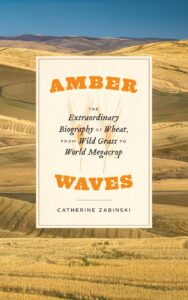
Along the way, he discussed the history of wheat, much of which was drawn from Dr. Catherine Zabinski’s Amber Waves, The Extraordinary Biography of Wheat, and included clips of an interview with Dr. Zabinski. It was fascinating, and interesting enough that I decided to buy the book. I just finished the book, and I’m glad I read it.
In the book, which she bills as a “biography” of wheat, Dr. Zabinski covers the history of the plant, starting way way back with the start of photosynthesis, to the development of cell walls, which allowed plants to have structure, to how our ancestors found a particular grass growing in the Middle East, and realized that its seeds were edible. From there she talks about the numerous “environmental sieves” — natural and human selection — that shaped wheat into the megacrop it is today.
For example, the earliest wild wheats, called einkorn, had seed tassles that tended to shatter when ripe, scattering the seeds on the ground where they would plant themselves. Along the way, there was a mutation that caused the seed heads not to shatter. This is not so good for the plant, as the seeds don’t hit the ground, but it also made the seeds easier to harvest, so the humans of that era tended to pick those seeds, and replant them, propagating that trait.
She also gets into the genetics of wheat. The bread wheat we grow today is the result of two natural hybridization events. In the first, wild einkorn hybridized with goatgrass, creating a variety of wheat called emmer. And then later, emmer hybridized again with goatgrass, creating a plant that produced seeds that were bigger and had softer husks, which were more easily removed — essentially, easier to prepare as food. From this natural hybridization, humans selected again and again — picking varieties that grew better under cultivation, or produced bigger fruit, or, as humans carried it all over the world, selected varieties that grew better under local conditions.
Dr. Zabinski discusses all of this, both from a cultural standpoint of how humans spread the crop and domesticated it, and from a biochemical standpoint, explaining in fairly easy to understand language how DNA works, how genetics work, how mutations occur, and how mutations and having a large genome to draw on, courtesy of the extra chromosomes the hybridization events that created bread wheat, allows for the necessary genetic variety that allows evolution to refashion the plant in ways that make it a viable crop in a variety of different environments.
From there she discusses how agriculture shaped human civilization — up until recently, it took a lot of work to harvest a crop, and governments and social structures grew up to mediate that need for labor and the distribution of food, and winds up with the developments of the twentieth century: mechanized agriculture, and the rise of plant breeders specifically trying to develop varieties with specific features, such as disease resistance, or shorter stems to reduce the risk of the plants flopping over, making them harder to harvest. This was the so-called Green Revolution, and she makes the point that part of the impetus for the Green Revolution was to combat the Red Revolution of Communism. She does discuss some of the downsides of the Green Revolution — the dangers of a plant monoculture lacking the genetic variety to cope with changes in the environment, and the ecological damage that agricultural practice can inflict, but she’s an optimist, and ends the book with a description of efforts to create a perennial variety of wheat by crossing it with wheatgrass; the advantage of a perennial vs an annual crop is that it’s less environmentally damaging.
Through it all, the book is clear, engaging, and easy to understand. I was a little concerned that it would be a dry, academic text, but it isn’t. She steers clear of jargon, and when she does introduce specialized terms, explains them well, and keeps her story moving. I read it on my iPhone and it’s the first book I’ve read start to finish in months.
Yesterday was the last day of Daylight Savings Time for 2025. By the time DST ends, I’m generally happy to see it go. Sunset is early enough that you’re not gaining all that much by extending it an hour, and sunrises have become late enough that you’re getting up in the dark.
This late sunrise does make it easier to be up and about for it, and so, for the past few years, I’ve tried to view it from the ocean. Generally, I don’t bother setting an alarm; if I oversleep, I figure I needed to. But the intention is usually enough to get me up. The past few years I’ve done it from Castle Island; this year, I was a little more confident I could get down to Nantasket in time.
One of the things I like to do this time of year is take the kayak out onto the Charles River on a sunny day. Last weekend was cloudy and rainy, so this weekend, I was looking forward to taking the kayak out one day, and the bicycle out the other.
Following the summer’s trip to the White Mountains on the motorcycle, I decided I wanted go back up for the fall foliage. I’ve done this a couple of times; last time I did this, in 2017, I did it over a weekend. I’ve also done it over the Columbus Day weekend. The trouble with doing it on the weekend, of course, is that when everyone else does it, so this year, I decided to take the first three days of October — Wednesday, Thursday, Friday off from work, and head up. It turned out to be a good move. There were a lot of other people around up there, but it wasn’t overwhelming.
Ten years ago, I wrote Hard to Believe, But Not Hard to Believe on the thirty-fifth anniversary of his death, the gist of that post being that it was hard to believe that it had actually been 35 years since his death. Now, ten years later, it feels like a lifetime.
For one thing, Mum is gone now too, as are all but one of his siblings, and all but one of his in-laws. I’ve written too many memorials over the past couple of years. But mainly, it’s that a lot has happened now, without him. My siblings married, a couple of them had children, and one of those grandchildren is now a mother herself. I’ve been through five jobs, two of them fairly lengthy, and I’ve now moved. He’s been out of the picture for way too long.
Anytime I think of the grandkids and Dad at the same time, I think of what a shame it was that they never knew him — Dad was great with kids. Before he married, he was a surrogate father to his dead brother’s daughters, and he was great with us, and my cousins and many of the kids in the neighborhood.
I would have loved to have gone picture taking with him. Dad was a great photographer, and not fully appreciated within the family. He would put on the occasional slide show of family pictures, but what I didn’t realize fully until after he was gone was that he had a bunch of pictures he didn’t show, because they weren’t people pictures — but they were really good. Dad started letting me use his cameras when I was in high school, but they were both rangefinders, with fixed lenses. I didn’t get my first SLR until the year after he died. I wish I could have gone shooting with him.
When he had the time, Dad loved to paint pictures of ships. Square riggers, especially, and clipper ships in particular. He would go downstairs late at night, put on the old radio, and paint. He started by taking slides of pictures in books, and then he would project the slide onto the blank canvas and trace the outlines. Sometimes I would wake up late at night, and somehow know he was down there — maybe I heard the radio? — and go downstairs and watch. I remember one night, he showed me how he was painting the roundness of a sail. He showed me how he painted the shadows in the corners of the sail, and the brightness in the belly of the sail. And he knew the history of them; I remember one night, his subject was a Black Ball packet ship, and him telling me about them. I remember him mentioning that the lights in the cellar where he was painting were relatively yellow, and that was why the color palette of his paintings was blueish. I was fairly young during the years when he was doing most of his painting, and the memories have grown blurry, but they’re my favorite memories of him.
Dad was a Boston patrolman, and a good one. When I was going through the papers Mum had saved, I found two separate letters of commendation he had received. He liked to help people, and couldn’t abide cruelty.
Dad loved the outdoors, especially the Blue Hills. There was a short-lived mountain bike rental concession near Trailside Museum, and I tried it out. I remember thinking the whole time, God, Dad would have loved this.
It’s been too long without him.
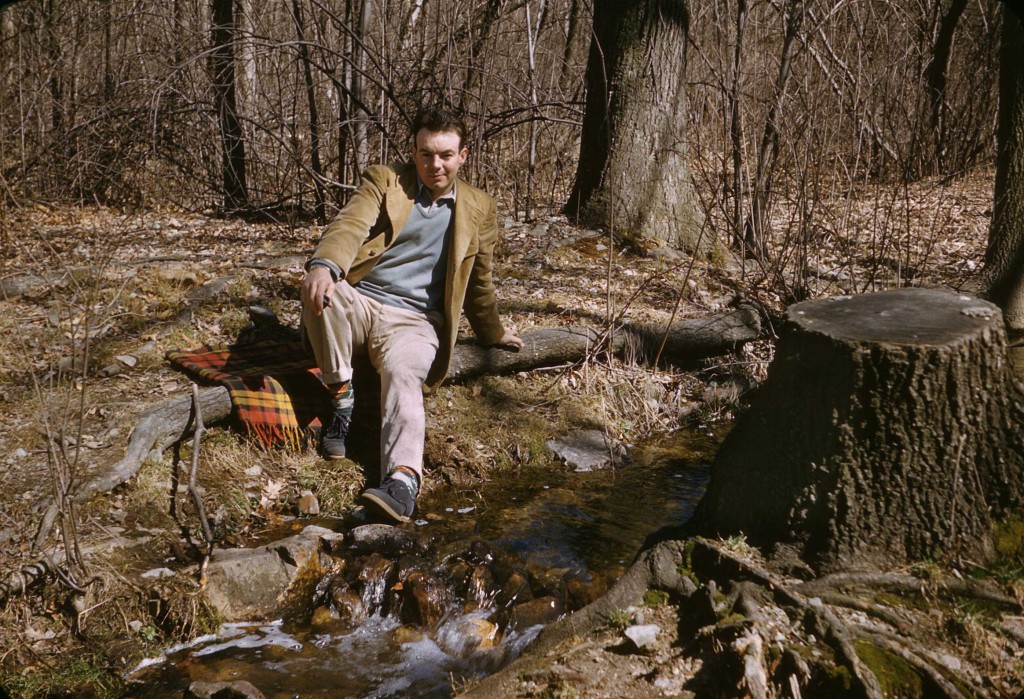
Dad as young man. Self-portrait in the Blue Hills.
I’ve been feeling that I’ve kind of let the summer slip away, so before it was completely over, I decided to take a couple of days off and take a trip on the motorcycle up to the White Mountains.