When I was a teenager, my Dad got into gardening; he had a big patch of tomatoes, plus some other vegetables, and I got into gardening with him. And one of the things we liked to do together was watch Crockett’s Victory Garden, hosted by Jim Crockett.
You could tell Crockett was not a television pro, but he was a born instructor. He’d written a number of gardening books, including a series for Time-Life, which led the producer, Russ Morash, to offer him the job. The format of the show was quite simple: Each week, Crockett would go through the garden and demonstrate the various jobs that needed to be done. The Victory Garden itself was a small plot outside the WGBH studios, and each week, Crockett would sow seeds, thin seedlings, weed, deadhead flowers and harvest vegetables; showing all the things that needed to be done, and more importantly, explained why they needed to be done. No garden tours, no guest gardeners, just simple explanations. Most everything I know about gardening, I learned from Crockett.
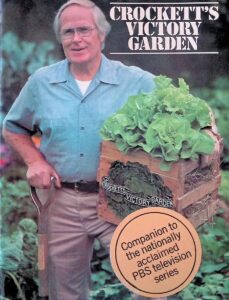
The show started locally in 1975, and became available to other PBS stations in 1976. Also in 1976, Crockett published the first of three companion books, Crockett’s Victory Garden. Unlike most gardening books, it’s organized by month, not plants. Each month details the jobs to be done that month, plus a feature germane to that month. The foreword describes how the series came to be. I still have my well worn copy, taped together but intact. It’s my gardening Bible.
The show continued for three or four years, and I watched it faithfully. Some years it ran seasonally; at least one year, it continued on through the winter, the whole show being shot in the greenhouse. I remember seeing one show where he remarked that they were shooting under floodlights; in hindsight, I wonder if that episode had aired live.
I still remember the horrible news in the spring of 1979 that Crockett was ill, and would have to be assisted by Bob Thompson. When that first show aired, it was dreadfully clear that Crockett was desperately iill; he was emaciated and frail, and Thompson handled most of the work of the garden. Shortly thereafter, he died.
Bob Thomson became the regular host of the show, and it was retitled The Victory Garden the following spring. But it just wasn’t the same. I didn’t care for Thompson, and the show spent less time in the original Victory Garden and more time at the suburban site — actually Russ Morash’s yard — and started adding features like cooking tips and interviews and garden tours. I suspect some of this was the natural evolution of the show that might have happened with Crockett as well, but it just wasn’t the same, and I lost interest.
It’s always surprised me that WGBH never dug into the archives to re-run the Crockett era episodes of The Victory Garden, and so I was delighted to see that they’ve finally started posting them to YouTube. The videos are a mix of shorts and full videos — or almost full videos — they’ve had to remove the theme music, Bill Spence’s recording of “Gaspe Reel” for copyright reasons. They’re careful to note in the descriptions that the episodes are a snapshot of gardening procedures from the mid-seventies, especially calling out the use of pesticides and fungicides that aren’t available anymore.
So what’s it like watching these episodes after fifty years? Crockett is still a damned good instructor, and the format of following him around the garden and watching him demonstrate things still works well.
I hadn’t realized back then, just how strong his New England accent was. The accent is authentically New England — he grew up in Haverhill. It’s not at all like the fake Boston accent you get from actors. He sounds a lot like a bunch of my older relatives and friends who aren’t around anymore, and you just don’t hear that accent anymore — it’s disappeared to a large extent over the decades. GBH has put together a couple of shorts gently poking fun at the accent.
I’d forgotten just how lush of a garden the Victory Garden was. The book focuses on closeups of individual plants, but watching him walk through the midsummer garden with all the beds overflowing with foliage was a good reminder of how impressive the show was. (To be fair, Crockett did not maintain the Victory Garden himself; it had a full time gardener doing the maintenance)
I’d forgotten how often he planted seeds directly into the garden. I’d gotten into the habit of mostly buying plants at a nursery and transplanting them into the garden; Crockett was, in fact a strong proponent of planting seeds directly, both for reasons of cost, and because of the greater variety available as seeds.
In his book, Crockett mentions how terrified he was at first, and it’s interesting, going through the episodes in sequence, seeing him become more at home in front of the camera. It’s clear he wasn’t reading from a teleprompter, as you can see him making false starts, then restarting a thought, but he became noticeably better as time went on.
I wish WGBH had’t had to remove the theme song. I understand they’re a big organization and can’t afford to trifle with copyrights, but I wish they could have come to an agreement with Spence or his estate to use the theme, or failing that, used a different version. “Gaspe Reel” is a traditional folk tune, and not itself under copyright. The channel appears to be monetized, so I think they could have earned the money back.
I also think they could have added some titling showing the varieties used, and calling out those procedures, like insecticide use, that are obsolete.
All in all, though, I’m grateful to WGBH for publishing these episodes. Even after all these years, I still feel this version of The Victory Garden is the best version, and I heartily recommend it.